Archaeological news about the Archaeology of Early Medieval Europe from the Archaeology in Europe web site

Tuesday, 18 February 2020

Pictish 'power centre' uncovered near Dunkeld

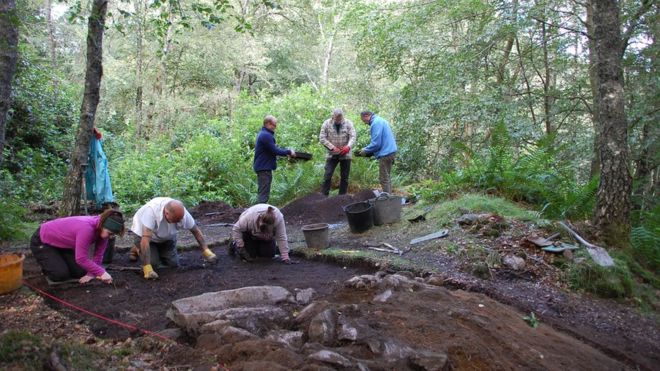
Archaeologists at King's Seat Hillfort last year
PKHT

A hilltop fort near Dunkeld was an important Pictish power centre, say archaeologists who excavated the site.

Evidence of metal and textile production were revealed at King's Seat Hillfort, a legally protected site.

Finds such as glass beads and pottery suggested the Picts who occupied the site in the 7th to 9th centuries had trade links with continental Europe.

Other finds included pieces of Roman glass that were recycled and reused as gaming pieces.

Read the rest of this article...

There are still a very few places available on the EMAS study tour to Orkney


EMAS Study Tour to Orkney
14 – 23 April 2020
Guide: David Beard MA, FSA, FSA Scot
The 2020 EMAS spring study tour will be to Orkney. We will travel by coach from Baker Street, London stopping overnight at Middlesbrough and Inverness and visiting archaeological sites on the way.
We will be based in Kirkwall, and will visit sites on Orkney Mainland and the islands of Egilsay, Rousay and Wyre. The sites that we will visit include Maes Howe, Skara Brae, Midhowe Broch, the Brough of Birsay, Cubbie Roo’s Castle, the Earl’s Palace at Birsay and Kirkwall Cathedral.
Further information...

Monday, 10 February 2020

Ancient Viking Glass Artifact Was A Game Piece Of The Elites


A tiny glass crown is being heralded as a rare archaeological artifact from the first wave of Viking raids in England.

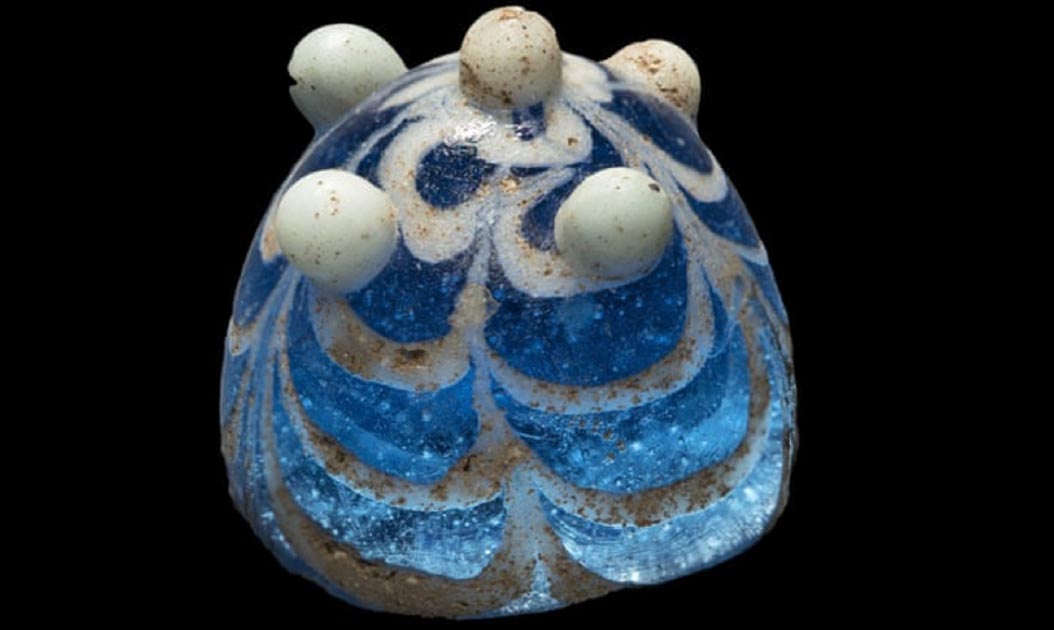
The small worked glass artifact was unearthed at an excavation site on the Holy Island of Lindisfarne , a tidal island situated off the northeast coast of England in Northumberland. Crafted from swirling blue and white glass with white glass bobbles, a report in The Times says archaeologists believe the crown was a gaming piece from the strategy board game  hnefatafl (king’s table) played in Britain, Ireland, and Scandinavia before the arrival of chess in the 12th century.

A Glass Artifact With Elite Origins
The relic, which is no bigger than a grape, is described as being “of exquisite workmanship” showing influence from across the North Sea and if it is indeed a hnefatafl gaming piece it is a rare archaeological treasure linking the English island with the Vikings at the beginning of a turbulent period in English and Scandinavian history.

Read the rest of this article...

Thursday, 6 February 2020

Board-game piece from period of first Viking raid found on Lindisfarne

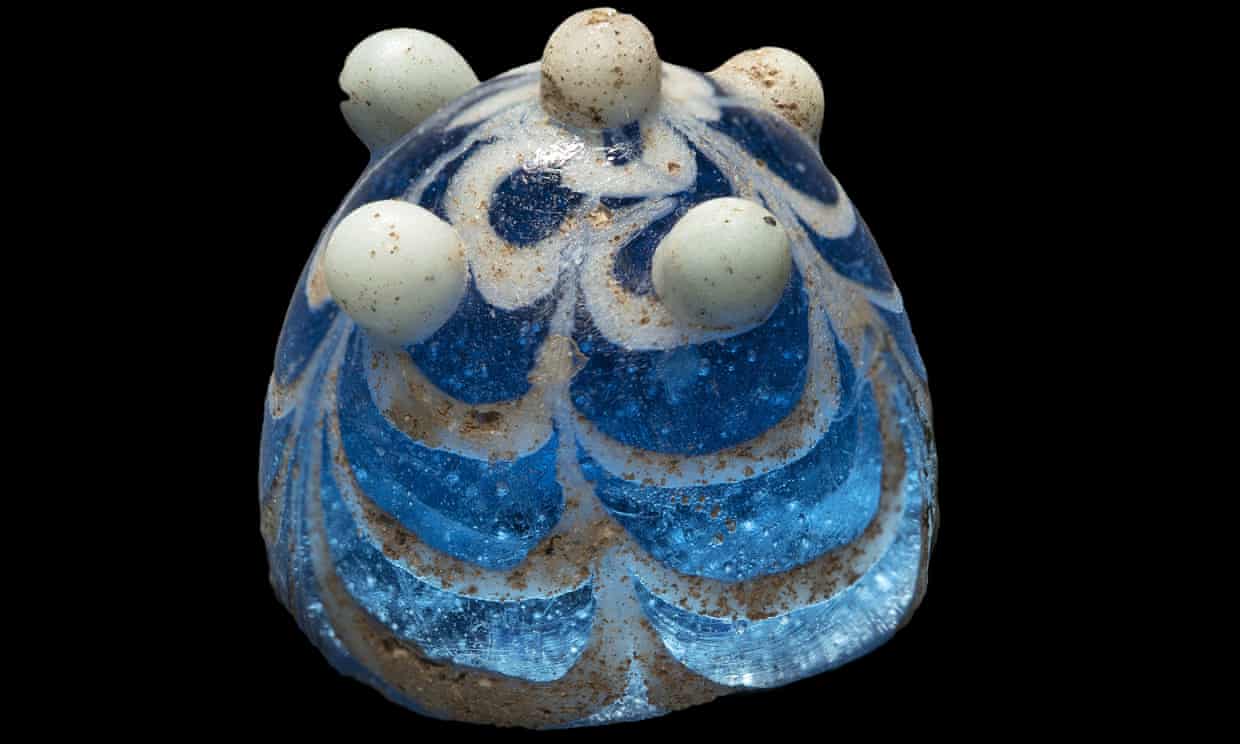
The piece of worked glass unearthed during an excavation on Lindisfarne. 
Photograph: Jeff Veitch

Small glass ‘crown’ thought to be rare archaeological link to first Norse raiders

It is not large – the shape and size of a chocolate sweet – and might easily have been discarded as a pebble by a less careful hand.

But a tiny piece of worked glass unearthed during an excavation on Lindisfarne has been revealed to be a rare archaeological treasure linking the Northumbrian island with the Vikings, from the very beginning of one of the most turbulent periods in English history.

Archaeologists believe the object, made from swirling blue and white glass with a small “crown” of white glass droplets, is a gaming piece from the Viking board game Hnefatafl, or a local version of the game.

Whether dropped on the island by a Norse raider or owned by a high-status local imitating their customs, the gaming piece offers a rare tangible link between Lindisfarne’s Anglo-Saxon monastery and the culture that eventually overwhelmed it.

Read the rest of this article...

Wednesday, 5 February 2020

1,300-Year-Old Saxon Coin Found by Treasure Hunter Rewrites English History


An English metal detectorist has found a rare coin proving old London did not fall to the West Saxons until later than currently thought.

Buried about four inches deep, Andy Hall, 55, found the 1,300-year-old coin in January of 2016 on Wiltshire farmland at Coombe Bisset, to the southwest of Salisbury in  England. While the artifact’s authenticity had been doubted, with even the finder suspecting that it may have been a contemporary forgery, or what he calls a “19th century fantasy piece,” scientific tests on the silver coin have confirmed it is “95% per cent silver,” which is consistent with coins of the time.

Dating of The Fall Of London Challenged
The controversy arises because the rare silver piece depicts the face of the Saxon king Ludica of Mercia who ruled for just one year from 826–827 AD. This little known Saxon king, Ludica, who ruled the kingdom that included London, or 'Lundenwic' as it was called at the time, challenges the mainstream historical theory that London had fallen to the Wessex King Ecgberht after the Battle of Ellendun in 825 AD.

Read the rest of this article...

Saturday, 1 February 2020

First Byzantine Monastery discovered in Spain

Emperor Justinian, Ravenna
[Credit: El Pais] 

Archaeological experts from the University of Alicante in Spain have recently identified the first Byzantine monastery ever found on the Iberian peninsula.
They first came across several round metal objects at the archaeological site, which is located in the area of Elda, Alicante. The exact identification of these objects had proven to be a mystery since the 19th century.

In the 6th century, Emperor Justinian forced people to keep a cache of state-minted coins in the main churches of each city. In this way, merchants could show that the coinage they used in economic transactions corresponded with the official money that the Emperor had minted.

The churches used to work as guarantors that buyers of precious metals were not cheated and that the coins in general use had the actual value that they were meant to have. If the operations were fraudulent, the tax revenue was lower — something the Emperor kept close tabs on.

Read the rest of this article...

The ghostly treasure ship of Sutton Hoo

Silver bowl from Sutton Hoo. Seventh century, British Museum, London
PHOTOGRAPH BY ULLSTEIN BILD, CORDON PRESS

In 1939 a series of mounds at Sutton Hoo in England revealed their astounding contents: the remains of an Anglo-Saxon funerary ship and a huge cache of seventh-century royal treasure.

IN SOUTHERN ENGLAND near the Suffolk coast lies a stretch of sandy heathland dotted by mysterious mounds of earth. Inspiring strange tales and superstitions among local people, these barrows charmed newlyweds Frank and Edith Pretty, who purchased the property, known as Sutton Hoo, in 1926.

The couple made their home at Sutton Hoo for nearly nine years until Frank’s untimely death in late 1934. Edith continued to live there, and she grew increasingly curious about the barrows on her property. A lifelong fascination with the occult had led her, like many wealthy women of her time, to consult spiritualists in London. Some say that after her husband’s death, her interest in spiritualism grew and even expanded to include the barrows on her property. Disputed accounts even describe Edith as having a vision of a ghostly procession passing through the mounds near her house. Whatever the true cause, she decided in 1937 to have the land excavated and approached a museum in nearby Ipswich to discuss it.

What lies beneath
Self-taught archaeologist Basil Brown worked as an excavation assistant at the museum and took on Edith’s project. His decision to take the job not only would change his life but also radically alter, and deepen, the understanding scholars had of the early Anglo-Saxon period in England following the collapse of Roman rule.

Read the rest of this article...