Archaeological news about the Archaeology of Early Medieval Europe from the Archaeology in Europe web site

Friday, 12 November 2021

Metal detectorist unearths largest Anglo-Saxon treasure hoard ever discovered in England

 A number of gold coins and objects from the Norfolk hoard (Image credit: British Museum) 

A metal detectorist in West Norfolk, England, has unearthed the largest Anglo-Saxon treasure hoard ever discovered: a bounty of 131 coins and four golden objects. Most of the items were found over the course of six years by a single detectorist, who wishes to remain anonymous, according to the British Museum. 

Ten of the coins were dug up by former-police officer David Cockle, also using a metal detector, the Evening Standard reported. However, Cockle kept his discovery secret and then illegally sold the coins for 15,000 British pounds (about $20,000), according to BBC News. When the authorities discovered his theft in 2017, he was charged with converting criminal property and sentenced to 16 months in prison for "pure greed," presiding Judge Rupert Overbury said at the sentencing. Cockle was also dismissed from the police force. Of the 10 coins he sold, eight have been recovered.

Read the rest of this article...

First finished pieces of Sutton Hoo replica ship joined together


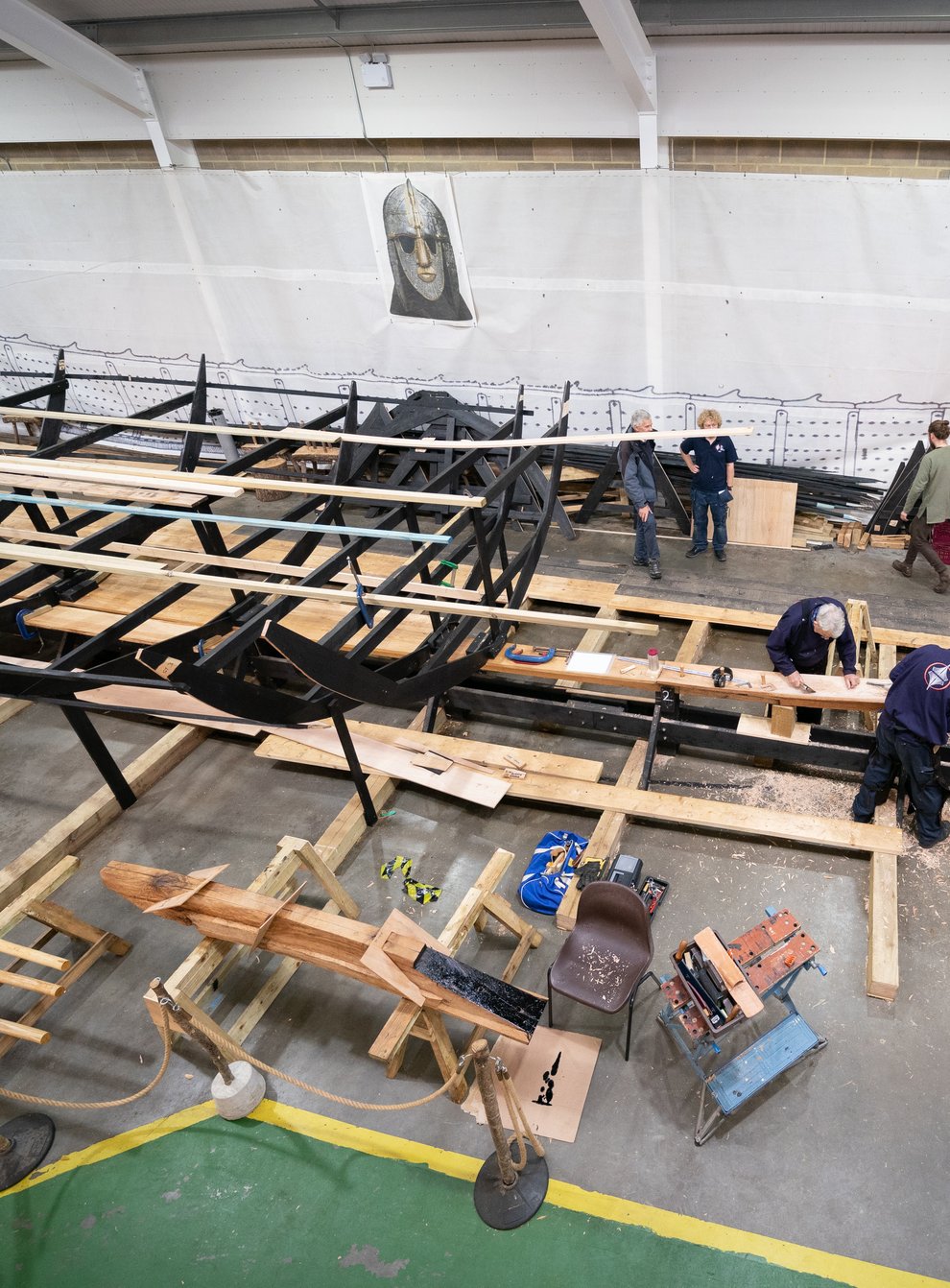
The first two finished pieces of an 88ft-long replica of the Sutton Hoo longship have been joined together.

Archaeologist Angela Care Evans, who worked on a dig at Sutton Hoo in the 1960s while working as a research assistant for the British Museum, knocked in the first of three wooden pegs to join the keel to an extension piece.

The full-size reconstruction of the Saxon ship that was excavated in 1939 is being built in a shed beside the River Deben in Woodbridge, Suffolk.

It is to be made of oak donated by Suffolk farmers and secured with iron rivets.

Dating from the early 7th century, the original Sutton Hoo longship has been described as a ghost ship, as its timber had rotted away in the acidic soil, leaving only an imprint in the sand.

The project’s master shipwright, Tim Kirk, said: “Through building this, and it is really just a big experimental archaeology programme, we’re hoping to learn how the ship actually sailed.

Read the rest of this article...
Tuesday, 9 November 2021

A Viking axe struck a Newfoundland tree in the year 1021. Here’s how scientists proved it


Hundreds of years before Christopher Columbus, the Norse became the first Europeans to cross the Atlantic and settle in North America. This long-posited theory was finally proven in the 1960s, following an archeological expedition to the site of L’Anse aux Meadows on the northernmost tip of the island of Newfoundland. Until recently, the exact timing of the Viking settlement was only speculation, based on architectural remains, a few surviving artefacts and interpretations of Icelandic sagas written in the 1200s. But, as this video from Nature explains, using new carbon dating techniques, scientists at the University of Groningen in the Netherlands have found the exact year that a tree was felled by a Viking axe – 1021 CE. Further, this research also marks the earliest known point in history by which human migration had encircled the globe.

Watch the video...

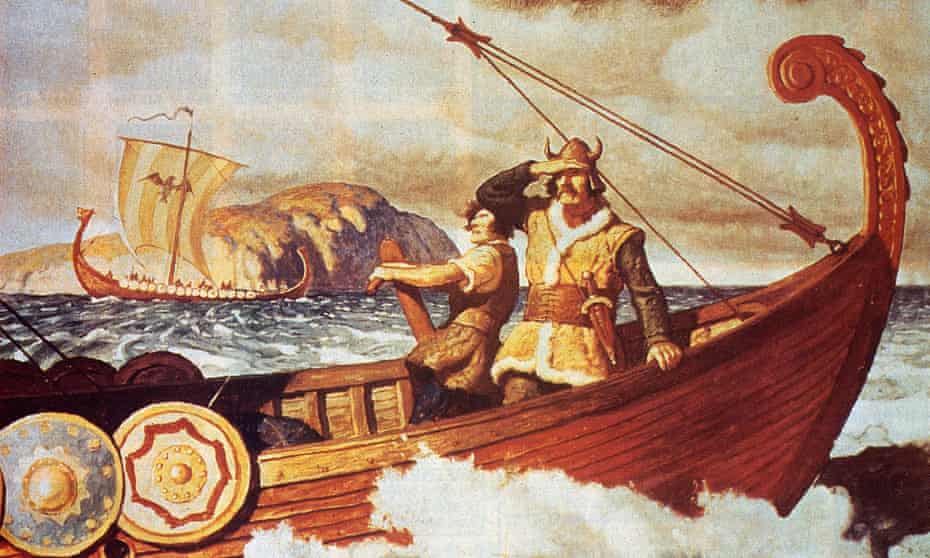
Did Vikings and their stowaway mice beat Portugal to the Azores?

Vikings, as imagined by NC Wyeth, and their stowaway mice are now thought to be the earliest settlers on the Azores. Photograph: Hulton Archive/Getty

They came from the land of the ice and snow and the midnight sun – but still ended up in some balmy destinations. This is the conclusion of researchers who have discovered evidence to support the idea that the Vikings settled on the clement shores of the Azores several hundred years before the Portuguese arrived in 1427.

Given that the Vikings are usually associated with the frozen north, the claim is startling. Nevertheless, it is based on solid science, says a group of international researchers who recently analysed lakebed sediments in the Azores, an archipelago in the mid-Atlantic.

These were found to be rich in organic compounds that are found in cow and sheep faeces. At the same time, these samples were also found to contain high levels of charcoal but were low in pollen from native trees.

Read the rest of this article...

Wednesday, 20 October 2021

Breakthrough Discovery Shows Vikings Were Active in North America 1,000 Years Ago

Reconstruction of a Viking building near L’Anse aux Meadows. (Glenn Nagel Photography)

New archaeological evidence has allowed scientists to refine the timeline for the Viking presence in North America.

Pieces of wood scarred with cut marks have been precisely dated to the year 1021 CE – exactly 1,000 years ago – and the metal tools that made those marks were not produced by the indigenous population, according to a team of archaeologists led by the University of Groningen in the Netherlands.

Vikings, however, did make and use metal tools, and were known to have settled at the archaeological site of L'Anse aux Meadows, where the wood was found.

This is the earliest and most accurate date yet not just for the European settlement of the Americas, but for circumnavigation of the globe, the researchers said, giving us a definitive reference point for understanding the global transference of knowledge, goods, and genetic information.

Read the rest of this article...

When the Vikings reached the Americas

Reconstructed Viking-Age building adjacent to the site of L’Anse aux Meadows. 
Credit: Glenn Nagel Photography

New research from the Netherlands has more accurately dated a Viking settlement in Newfoundland, Canada, revealing that the seafaring people were active in North America by at least AD 1021.

Vikings are known to have sailing vast distances in their iconic longships, and forays into a mysterious foreign land out to the west were described in ancient sagas, but these stories were thought to be fantasy until the 1960s discovery of Norse buildings at L’Anse aux Meadows in Newfoundland.

A new study from the University of Groningen, Netherlands, published today in the journal Nature, has revealed the most accurate dating yet of the L’Anse aux Meadows site.

In order to accurately place L’Anse aux Meadows in history, the researchers studied three pieces of wood from archaeological contexts containing Viking materials. Each piece showed clear evidence of being cut with metal, a material First Nations Americans weren’t using at that time.

Read the rest of this article...

Tuesday, 12 October 2021

Word Of Viking Settlements In North America Reached Italy 150 Years Before Columbus


Word of the Viking exploration of North America appears to have reached Genoa, Christopher Columbus's hometown in Italy, centuries before Columbus sailed. This conclusion, based on a translation of a 14th-century history raises the possibility the Viking settlements in Vinland had previously unrecognized influence on subsequent events.

Around 1345, Galvaneus Flamma, a Milanese Dominican friar, wrote a document called Cronica universalis. The original was lost, but a copy made 50 years later was rediscovered in 2013. Professor Paolo Chiesa, an expert in Medieval Latin at the University of Milan, has made a translation. In the journal Terrae Incognitae, Chiesa reports that a portion of the text refers to Markalada, west of Greenland.

Four Icelandic sagas include accounts of Markland, thought to be modern Newfoundland or Labrador.

Flamma attributes this information to Genoese sailors, and Chiesa sees this as evidence that knowledge of the Viking voyages had reached Italy 150 years before Columbus arrived in the Americas.

Read the rest of this article...