Archaeological news about the Archaeology of Early Medieval Europe from the Archaeology in Europe web site

Friday, 10 January 2014

New Iron Age Sites Discovered in Finland

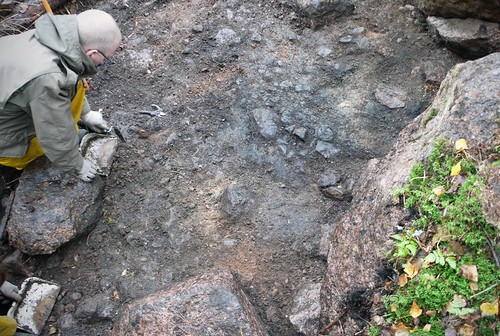
A National Board of Antiquities archaeologist excavates at the Ahvenkoski harbor forge. The furnace was located between two stones, and in the ground one can see dark gray iron slag pieces. Image courtesy Jouni Jäppinen.

It was in the autumn of 2010 when local amateur archaeologists discovered evidence of harbor facilities thought to date from around 1000–1200 AD near Ahvenkoski village at the mouth of the western branch of the Kymi River in southeastern Finland. The findings included a smithy, an iron smelting furnace, and forceps, as well as hundreds of iron objects such as boat rivets similar to those found at Viking settlements in different parts of the Baltic, Scandinavia, Scotland and Iceland. Then, in 2011, a possible 2 x 3-meter-wide cremation grave was uncovered, confirmed later through rescue excavations by archaeologists from the Finnish National Board of Antiquities and through osteological analysis at the University of Helsinki. Artifacts included a battle axe, a knife, and a bronze buckle, all associated with burned human bones, initially thought to be dated to around 1000 - 1200 CE before analysis. Similar objects have been discovered in the Baltic Sea area and in Ladoga Karelia. Identical cape buckles have also been found in Gotland. 

Read the rest of this article...

Network theory and the heroes of Icelandic sagas

Egill Skallagrímsson from a 17th-century manuscript [Credit: WikiCommons] 

The Icelandic sagas of the Norse people are thousand-year-old chronicles of brave deeds and timeless romances, but how true to Viking life were they? Writing in Significance, Pádraig Mac Carron and Ralph Kenna use a statistical network of associations between characters to find out. 

While the stories involve a cast of thousands, recurring characters have emerged as the stories passed into historical legend. A set of recurring characters living within the same fictional world is not restricted to ancient stories, such as the Norse or Greek myths, but remains a popular device in modern comic and film franchises. 

By exploring the number of ‘too-good-to-be-true’ interactions between protagonists, the researchers built a network of recurring characters which in turn could help reveal if the stories are invented or if they are based on a real society.

Read the rest of this article...

Karl der Große: Macht, Kunst, Schätze


Karl der Große: Macht, Kunst, Schätze - three major exhibitions which will run in Aachen from 20 June to 21 September 2014 to mark the 1200th anniversary of the death of Charlemagne.

The three exhibitions are listed as:

Places of Power
The exhibition in the town hall’s coronation hall, the former kings’ hall of the palace, focuses on Charlemagne’s imperial palaces.

Charles’s Art
At the Centre Charlemagne, a new exhibition housed in the heart of the imperial palace, the golden age of culture during the Carolingian period is presented with top-class works of art.

Lost Treasures
In the cathedral’s treasure chamber next to Carolingian Marienkirche, precious church treasures from the Carolingian period and the Middle Ages return to their original site once again.

This should prove to be the most important Carolingian exhibition since the 'Karl der Große und Pabst Leo III. in Paderborn' exhibition held in 1999.

Go to the exhibition website...

Looted Viking treasure is discovered in British Museum store

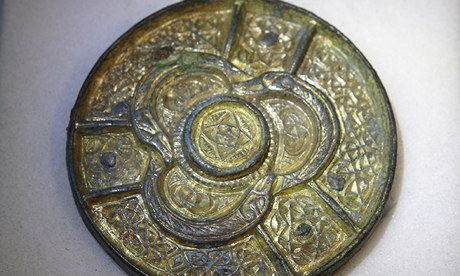
The Celtic brooch looted by the Vikings and discovered in the museum's collection. Photograph: Andy Hall for the Observer
A Celtic treasure looted by the Vikings more than 1,000 years ago has been discovered in the British Museum's storerooms. An ornate, gilded disc brooch dating from the eighth or ninth century was found by chance and is being described as a "staggering find". No-one knew of its existence until now.
It had been concealed in a lump of organic material excavated from a Viking burial site at Lilleberge in Norway by a British archaeologist in the 1880s and acquired by the British Museum in 1891.
Curator Barry Ager, a Vikings specialist, was poring over artefacts before a visit from a Norwegian researching the Viking site when his eye was caught by some metal sticking out of the side of the organic lump.
Read the rest of this article...

1,000-year-old loot found in British Museum store

The Celtic brooch looted from the Vikings and discovered in the museum's collection 
[Credit: Andy Hall for the Observer] 

A Celtic treasure looted by the Vikings more than 1,000 years ago has been discovered in the British Museum's storerooms. An ornate, gilded disc brooch dating from the eighth or ninth century was found by chance and is being described as a "staggering find". No-one knew of its existence until now. 

It had been concealed in a lump of organic material excavated from a Viking burial site at Lilleberge in Norway by a British archaeologist in the 1880s and acquired by the British Museum in 1891. 

Read the rest of this article...

RAISING A HORN TO NORDIC DRINKING HERITAGE


Anew book describes the fascinating history of drinking horns and their importance within Scandinavian culture where their roots stretch back into at least the Iron Age as several graves have been found to contain examples from this period.

A long history

During Classical Antiquity, it was the Thracians and Scythians who were known for their custom of drinking from actual horns but in Bronze Age Mycenaean Greece, although they had retained their shape the materials used were clay or metal. Their spread across Central Europe and into Scandanavia by the 5th century BC can be traced by their fittings found in various graves.
The Gallehus horns, discovered north of Møgeltønder in Southern Jutland, Denmark, were created from sheet gold. Designed to look like auroch horns, they were found in 1639 and in 1734 respectively at locations only 20 metres apart and date to the early 5th century BC. Sadly the originals were stolen and melted down in 1802.

Read the rest of this article...

Sweyn Forkbeard: England's forgotten Viking king

Sweyn Forkbeard (shown left), England's shortest reigning king, remains in the shadows of both his son Canute the Great, and father Harold Bluetooth

On Christmas Day 1013, Danish ruler Sweyn Forkbeard was declared King of all England and the town of Gainsborough its capital. But why is so little known of the man who would be England's shortest-reigning king and the role he played in shaping the early history of the nation?
For 20 years, Sweyn, a "murderous character" who deposed his father Harold Bluetooth, waged war on England.
And exactly 1,000 years ago, with his son Canute by his side, a large-scale invasion finally proved decisive.
Read the rest of this article...