Archaeological news about the Archaeology of Early Medieval Europe from the Archaeology in Europe web site

Tuesday, 17 April 2018

Germans find 'Harald Bluetooth' medieval treasure

Harald Bluetooth might have buried the treasure while fleeing from enemies

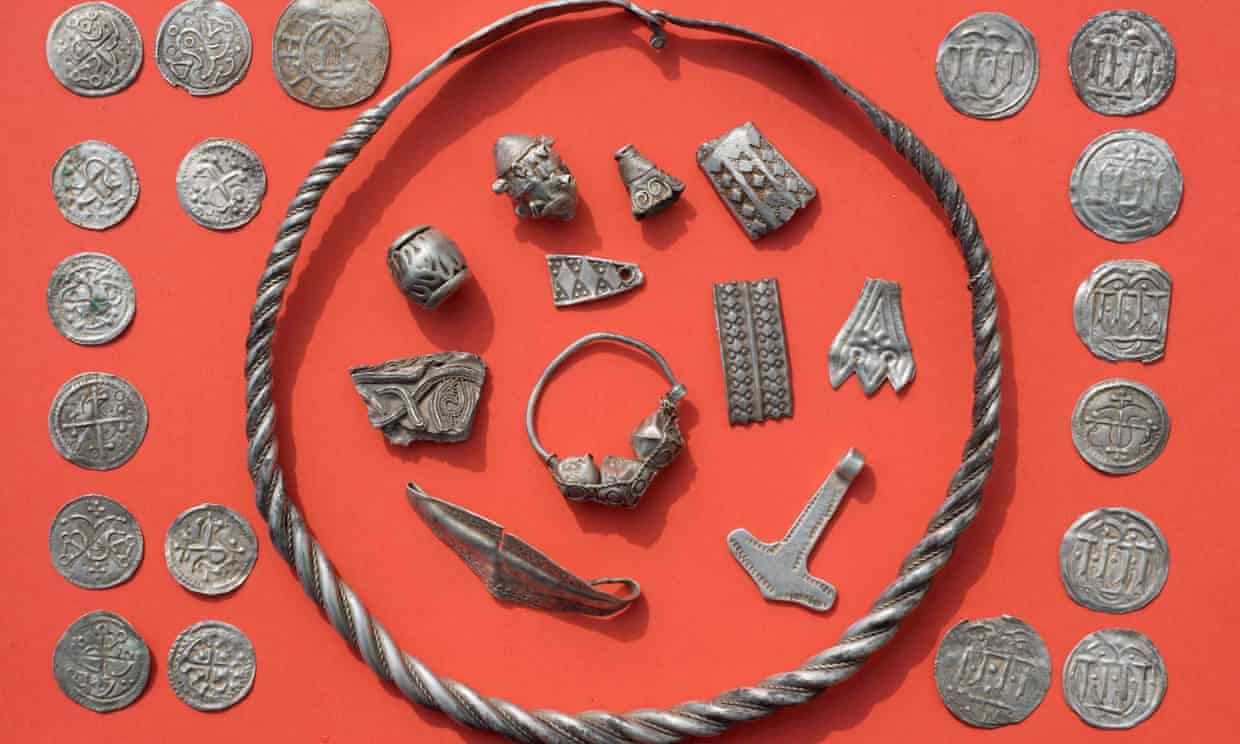
Treasure linked to the reign of 10th Century Danish King Harald Bluetooth has been dug up in northern Germany.

An amateur archaeologist and a 13-year-old boy found a silver coin on the Baltic island of Rügen in January when scanning a field with metal detectors.

Experts kept the find secret until a team dug up 400sq metres (4,300sq ft) of land at the weekend.

They found braided necklaces, a Thor's hammer, brooches, rings and about 600 coins, probably buried in the 980s.

"This trove is the biggest single discovery of Bluetooth coins in the southern Baltic sea region and is therefore of great significance," said lead archaeologist Michael Schirren.

Read the rest of this article...

Monday, 16 April 2018

Computer simulations show Viking's sunstone to be very accurate

The "Lofotr" viking ship and the smaller "femkeiping". Both recosntructions based on excavations from the Gokstad find. Credit: Geir Are Johansen/Wikipedia

A pair of researchers with ELTE Eötvös Loránd University in Hungary has run computer simulations that suggest that tales of Vikings using a sunstone to navigate in cloudy weather might be true. In their paper published in Royal Society Open Science, Dénes Száz and Gábor Horváth describe the factors that contributed to their simulations and what they found by running them.

For the time period 900 to 1200 AD, Vikings, by nearly all accounts, ruled the northern Atlantic. Their skill in building strong boats and in navigation allowed them to travel throughout the North Atlantic. Prior research has suggested the Vikings used a type of sundial to navigate, which was apparently quite accurate. But what did they do when it was cloudy or foggy? Viking tales passed down through the generations claimed it was through the use of sunstones, which allowed Viking navigators to find the sun even on cloudy days. But proving the tales true has been problematic—no sunstone has ever been found on or near a Viking shipwreck. A crystal was found on a 16th-century English shipwreck in 2002—and English sailors could have learned to use them from the Vikings—but much stronger evidence is needed.

Read the rest of this article...

Boy unearths treasure of the Danish king Bluetooth in Germany

Discovery by a 13-year-old and an amateur archaeologist leads to hoard linked to king who brought Christianity to Denmark

Part of the hoard linked to Bluetooth, the Danish king who reigned from around AD958 to 986. Photograph: Stefan Sauer/AFP/Getty Images

A 13-year-old boy and an amateur archaeologist have unearthed a “significant” trove in Germany which may have belonged to the Danish king Harald Bluetooth who brought Christianity to Denmark.

René Schön and his student Luca Malaschnitschenko were looking for treasure using metal detectors in January on northern Rügen island when they chanced upon what they initially thought was a worthless piece of aluminium.

But upon closer inspection, they realised that it was a piece of silver, German media reported.

Over the weekend, the regional archaeology service began a dig covering 400 sq metres (4,300 sq ft). It has found a hoard believed to be linked to the Danish king Harald Gormsson, better known as “Harry Bluetooth”, who reigned from around AD958 to 986.

Read the rest of this article...

Friday, 30 March 2018

Anglo-Saxon settlement and Roman army camp found in A14 bypass dig

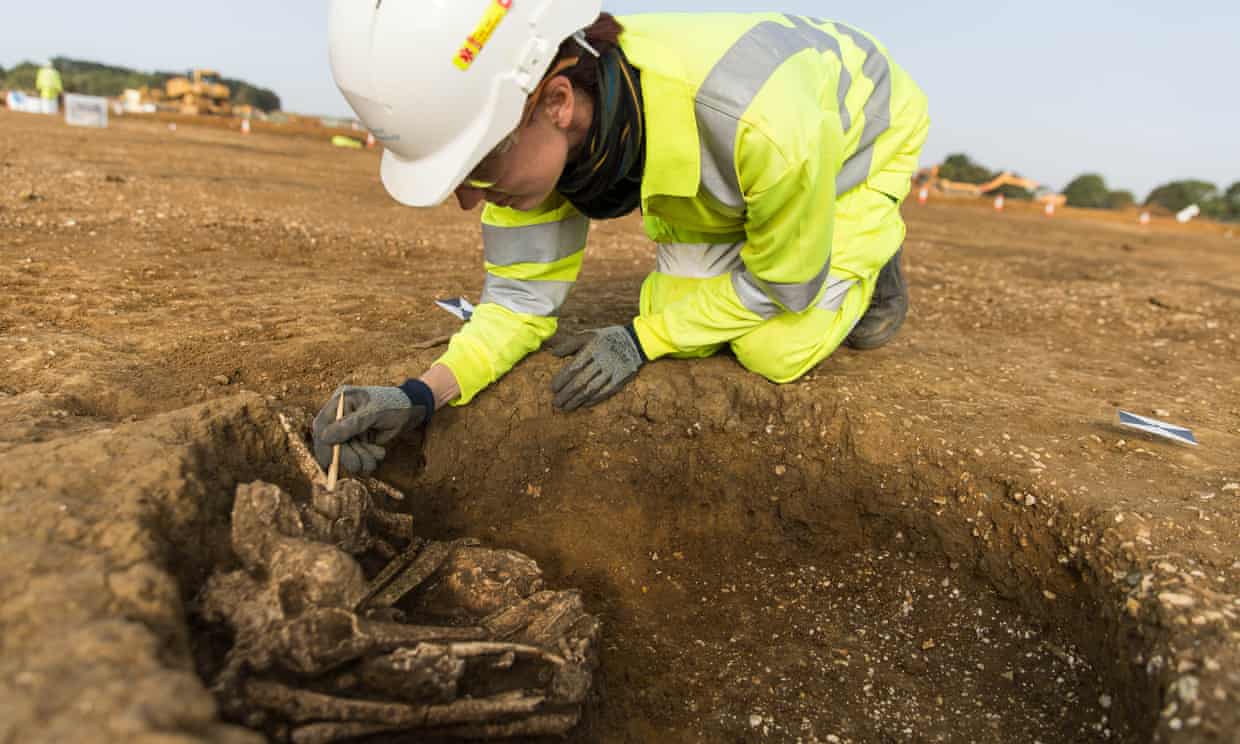
An archaeologist excavates a skeleton in Cambridgeshire. Photograph: Highways 
England/MOLA Headland Infrastructure

It’s taken more than 700 years, but the medieval villagers of Houghton in Cambridgeshire have had the last laugh: the foundations of their houses and workshops have been exposed again, as roadworks carve up the landscape they were forced to abandon when their woodlands were walled off into a royal hunting forest.

Their lost village has been rediscovered in an epic excavation employing more than 200 archaeologists, working across scores of sites on a 21-mile stretch of flat Cambridgeshire countryside, the route of the upgraded A14 and the Huntingdon bypass.

Much of it is now flat and rather featureless farmland, but the excavations have revealed how densely populated it was in the past, with scores of village sites, burial mounds, henges, trackways, industrial sites including pottery kilns and a Roman distribution centre. The archaeologists also found an Anglo-Saxon tribal boundary site with huge ditches, a gated entrance and a beacon on a hill that still overlooks the whole region.

Read the rest of this article...

Tuesday, 27 March 2018

An Icelandic Epic Predicted a Fiery End for Pagan Gods, and Then This Volcano Erupted

The Codex Regius, an Icelandic collection of poems about pagan gods, contains 
a version of the Vǫluspá.
Credit: Werner Forman/Universal Images Group/Getty

A series of Earth-shattering volcanic eruptions in Iceland during the Middle Ages may have spurred the people living there to turn away from their pagan gods and convert to Christianity, a new study finds.

The discovery came about thanks to precise dating of the volcanic eruptions, which spewed lava about two generations before the Icelandic people changed religions.

But why would volcanic eruptions turn people toward monotheism? The answer has to do with the "Vǫluspá," a prominent medieval poem that predicted a fiery eruption would help lead to the downfall of the pagan gods, the researchers said.

Read the rest of this article...

Monday, 19 March 2018

Viking expert certain Norse seafarers visited Miramichi, Chaleur Bay

Birgitta Wallace, senior archaeologist emerita with Parks Canada, says she believes Vikings had summer camps in New Brunswick's Miramichi and Chaleur Bay area. 
(Contributed/Rob Ferguson)

Did Vikings visit New Brunswick's Miramichi and Chaleur Bay areas? According to the research done by Birgitta Wallace, senior archaeologist emerita with Parks Canada, they did. 

"I'm really convinced that the Vikings did visit that area. Not all my colleagues would agree with me," said the woman who's been studying Vikings for 50 years.

While she is certain the Vikings did spend time in Miramichi and Chaleur Bay, she says she is not hopeful of ever finding anything to prove it.

Wallace said she determined that the second location that Vikings visited in North America, known as "Hóp," meaning "tidal lagoon," was in the Miramichi and Chaleur region after she studied the Vikings sagas. She also drew on her extensive work at L'Anse aux Meadows, located on the very northern tip of Newfoundland. 

Read the rest of this article...

Archaeologists Closer to Finding Lost Viking Settlement

The only known Viking site in North America is located at L'anse aux Meadows, Newfoundland. It was declared a World Heritage site.
Credit: WendyCotie/Shutterstock

A lost Viking settlement known as "Hóp," which has been mentioned in sagas passed down over hundreds of years, is said to have supported wild grapes, abundant salmon and inhabitants who made canoes out of animal hides. Now, a prominent archaeologist says the settlement likely resides in northeastern New Brunswick.

If Hóp is found it would be the second Viking settlement to be discovered in North America. The other is at L'Anse aux Meadows on the northern tip of Newfoundland.

Over the decades, scholars have suggested possible locations where the remains of Hóp might be found, including Newfoundland, Prince Edward Island, New Brunswick (on the east coast of Canada), Nova Scotia, Maine, New England and New York. However, using the description of the settlement from sagas of Viking voyages, along with archaeological work carried out at L'Anse aux Meadows and at Native American sites along the east coast of North America, an archaeologist has narrowed down the likely location of Hóp to northeastern New Brunswick. The likeliest location there? The Miramichi-Chaleur bay area. 

Read the rest of this article...