Archaeological news about the Archaeology of Early Medieval Europe from the Archaeology in Europe web site

Monday, 15 October 2018

Norway makes rare discovery of Viking ship traces

FOX News

Archaeologists said on Monday they have found what they believe are traces of a Viking ship buried in southeast Norway, a rare discovery that could shed light on the skilled navigators' expeditions in the Middle Ages. 

The boatlike shape was detected about 50 centimetres underground in a tumulus, a burial mound, with the use of a ground-penetrating radar in Halden, a municipality located southeast of Oslo.

"In the middle of the mound, we discovered what is called an anomaly, something that is different from the rest and clearly has the shapes and dimensions of a Viking ship," Knut Paasche, an archaeologist at the Norwegian Institute for Cultural Heritage Research (NIKU), told AFP.

"What we cannot say for sure is the condition of the conservation. Yes there was a boat there, but it's hard to say how much wood is left," Paasche said.

Read the rest of this article...

Norway makes rare discovery of Viking ship traces

This handout picture released on 15 October 2018, by Norwegian Institute for Cultural Heritage Research (NIKU) shows an Image generated from a georadar, showing what archaeologists believe is a viking ship buried near Halden, some 150km south of Oslo, Norway. — AFP pic

“In the middle of the mound, we discovered what is called an anomaly, something that is different from the rest and clearly has the shapes and dimensions of a Viking ship,” Knut Paasche, an archaeologist at the Norwegian Institute for Cultural Heritage Research (NIKU), told AFP.

“What we cannot say for sure is the condition of the conservation. Yes there was a boat there, but it’s hard to say how much wood is left,” Paasche said.

The Vikings, Northern European warriors and merchants who sailed the seas between the 8th and 11th century, would bury their kings and chiefs aboard a boat hoisted onshore and left under a mound of earth.

Only three Viking ships in good condition have been discovered in Norway in the past, including the well-preserved Oseberg ship discovered in 1903. All three of them are now exhibited in a museum near Oslo.

Read the rest of this article...
Friday, 5 October 2018

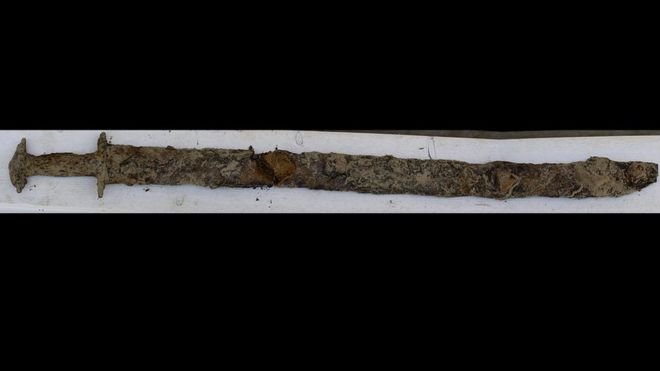
Eight-year-old Swedish-American girl pulls pre-Viking era sword from lake

Eight-year-old Saga and her sword. Photo: Andrew Vanecek
An eight-year-old Swedish-American girl came across an exciting find swimming at her local lake, when she pulled an ancient sword from its depths.
"It's not every day that one steps on a sword in the lake!" Mikael Nordström from Jönköpings Läns Museum said when explaining the significance of the find.

But that's exactly what happened to Saga Vanecek, who found the relic at the Vidöstern lake in Tånnö, Småland earlier this summer.

"I was outside in the water, throwing sticks and stones and stuff to see how far they skip, and then I found some kind of stick," Saga told The Local.

"I picked it up and was going to drop it back in the water, but it had a handle, and I saw that it was a little bit pointy at the end and all rusty. I held it up in the air and I said 'Daddy, I found a sword!' When he saw that it bent and was rusty, he came running up and took it," she continued.

The water at the lake by the family's summer house was low this year due to drought, which may have been part of the reason Saga was able to reach the sword. Because of this, the family was putting a buoy out in the lake to warn other boats of an underwater slab of concrete which was dangerous in the low water levels.
Read the rest of this article...

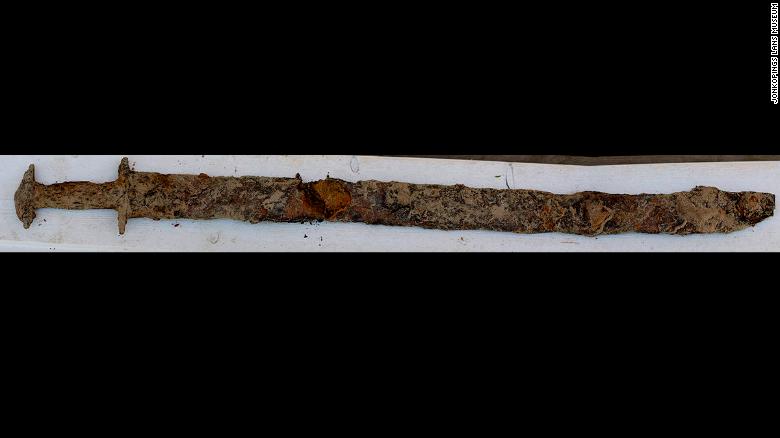
Girl, 8, pulls a 1,500-year-old sword from a lake in Sweden

JONKOPING COUNTY MUSEUM

An eight-year-old found a pre-Viking-era sword while swimming in a lake in Sweden during the summer.
Saga Vanecek found the relic in the Vidostern lake while at her family's holiday home in Jonkoping County.
The sword was initially reported to be 1,000 years old, but experts at the local museum now believe it may date to around 1,500 years ago.
"It's not every day that you step on a sword in the lake!" Mikael Nordstrom from the museum said.
The level of the water was extremely low at the time, owing to a drought, which is probably why Saga uncovered the ancient weapon.

Read the rest of this article...

Girl dubbed 'Queen of Sweden' after drawing ancient sword from lake


Experts have described the discovery of the 1,500 year old relic as spectacular, saying that it was "about 85 centimeters long, and there is also preserved wood and metal around it."

(CNN)An eight-year-old girl has discovered a pre-Viking-era sword in a Swedish lake, prompting locals to name her the "Queen of Sweden."

Swedish-American Saga Vanecek found the ancient artifact while playing in Vidöstern lake during the summer near her family's holiday home in the south of the country.
Experts at a local museum estimate the sword to be around 1,500 years old, according to local reports.

"I was outside in the water, throwing sticks and stones and stuff to see how far they skip, and then I found some kind of stick," Vanecek told The Local, a Swedish news website.

Read the rest of this article...

Tuesday, 2 October 2018

Playing Viking Chess with Whale Bones

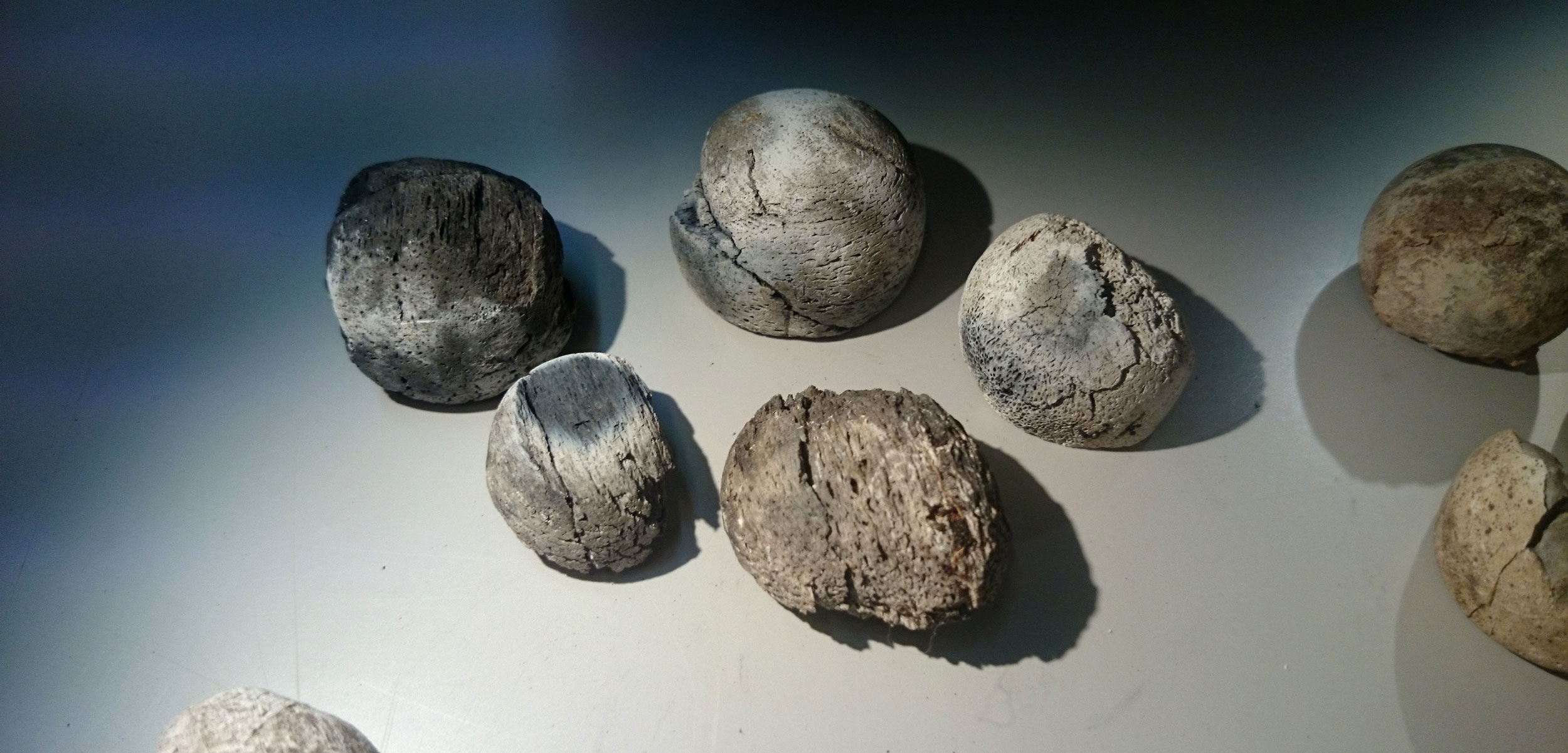
Researchers discovered hnefatafl game pieces made of whale bone in upper- and middle-class Vendel graves. Photo by Rudolf Gustavsson

Game pieces made of whale bone may be evidence of the emergence of industrial whaling in ancient Scandinavia.

In central and eastern Sweden from 550 to 793 CE, just before the Viking Age, members of the Vendel culture were known for their fondness for boat burials, their wars, and their deep abiding love of hnefatafl.

Also known as Viking chess, hnefatafl is a board game in which a centrally located king is attacked from all sides. The game wasn’t exclusive to the Vendels—people across northern Europe faced off over the gridded board from at least 400 BCE until the 18th century. But during the Vendel period, love for the game was so great that some people literally took it to their graves. Now, a new analysis of some hnefatafl game pieces unearthed in Vendel burial sites offers unexpected insight into the possible emergence of industrial whaling in northern Europe.

Read the rest of this article...

Monday, 1 October 2018

Fifth-century bishop’s residence found at Bulgaria’s Misionis site

Church baptistry [Credit: Sofia Globe]

One of the earliest bishop’s residences in Bulgaria has been found by archaeologists examining the ancient city and fortress of Misionis near Turgovishte. The building is estimated to date from the fifth century, the early Christian period.
During the 2018 archaeological excavations at the Misionis site, a baptistery was also found.

The bishop’s residence is close to one of the great basilicas in the archaeological complex. It is assumed that the threshold and the staircase led directly to the altar of the church.

This year’s excavations uncovered seven new buildings at the site to be examined. Bulgarian National Television reported archaeologists as saying that tourist interest in the ancient city was increasing.

Archaeological team head Professor Nikolai Ovcharov said that he was convinced that in the coming years, Misionis would become the “pearl of the Bulgarian north-east”.

Bulgaria’s Ministry of Culture has declared Misionis to be a site of national importance. The state is due to transfer the ownership to the municipality in order to facilitate the access of tourists.

Read the rest of this article...