Archaeological news about the Archaeology of Early Medieval Europe from the Archaeology in Europe web site
Sunday, 30 June 2013
In search of the lost city
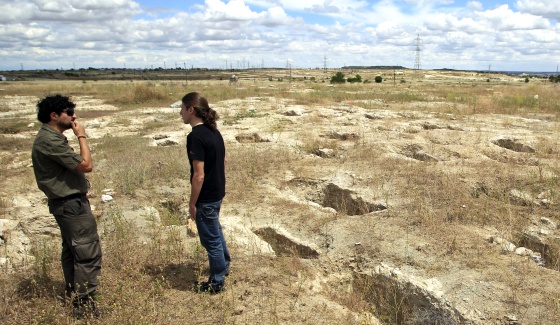
It doesn't have a name yet, but there is a search party out looking for it. It is the city that produced the 1,500 bodies found in the Visigothic necropolis of Vicálvaro, which the Madrid government has earmarked for destruction because it has "no relevance." The remains are thought to date back to between the fifth and eighth centuries AD.
Over this early burial site on an enormous dry plain, right next to the highway to Valencia, the Madrid government is planning to build a total of 15,400 housing units.
But before construction begins, regional authorities have granted permission to look for further traces of the people who once dwelled in these parts.
Read the rest of this article...
Friday, 28 June 2013
Gold Viking ingot discovered by amateur treasure hunter
A rare piece of Viking gold dating back more than a thousand years was discovered by an amateur with a metal detector in Northern Ireland, it was revealed.
The ingot is one of only a few nuggets known from Ireland, experts said Photo: PA
Tom Crawford was pursuing his hobby in farmland in Co Down last year when he found the small but precious ingot, which may have been used as currency during the 9th and 10th centuries. It is one of only a few nuggets known from Ireland, experts said.
Mr Crawford also uncovered a tiny silver ring brooch with unusual floral imprints, probably used for decoration by a man or woman during the Medieval period, a short distance away.
"It is all part of the big jigsaw of the history of this country," he told a Belfast inquest convened to establish if the find was treasure.
Viking gold unearthed by treasure hunter in County Down
Tom Crawford found the ingot in Brickland last year
A treasure hunter armed with a metal detector has unearthed a rare piece of Viking gold that is more than 1,000 years old.
Tom Crawford was sweeping farmland in County Down last year when he found the small ingot which may have been used as currency during the 9th and 10th centuries.
Experts said only a few such nuggets had been found in Ireland.
Close by, he found a tiny silver ring brooch dating from medieval times.
Read the rest of this article...
Isle of Man Viking silver declared 'treasure trove'
Four Viking silver objects have now been dug up in the same Isle of Man field
Three pieces of Viking silver dating back 1,000 years, discovered using a metal detector in the Isle of Man, have been declared treasure trove.
An inquest heard the three items, found by Seth Crowe in a field in Andreas in April, date back to between 930 and 1080 AD.
Archaeologists believe the two silver ingots and brooch fragment contain more than 60% silver.
Coroner of Inquests John Needham made the ruling at Douglas Courthouse.
Mr Crowe, 39, made the discovery having sought the permission of the landowner Leslie Faragher, some years ago.
Read the rest of this article...
Tuesday, 25 June 2013
The Sutton Hoo Online Exhibition
In 1939, just before the outbreak of the Second World War, an archaeologist named Basil Brown excavated the largest of 18 burial mounds in the grounds of a country house at Sutton Hoo in the east of England. What he discovered turned out to be a spectacular undisturbed burial.
Placed inside a vast ship, were the extraordinarily rich belongings of a high-ranking Anglo-Saxon man, possibly even a king...
View the online exhibition...
From Sutton Hoo to the soccer pitch: culture with a click
Museums, libraries and galleries are a tourist staple of the summer holiday season. Often they’re the first place we head to when visiting a new city or town in order to learn about the heritage of that country. Though only a lucky few have the chance to travel to see these treasures first-hand, the Internet is helping to bring access to culture even when you can’t visit in person.
At the Google Cultural Institute, we’ve been busy working with our partners to add a range of new online exhibitions to our existing collection. With more than 6 million photos, videos and documents, the diversity and range of subject matter is large—a reflection of the fact that culture means different things to different people. What the exhibitions have in common is that they tell stories; objects are one thing but it’s the people and places they link to that make them fascinating.
The British Museum is the U.K.’s most popular visitor attraction and the 4th most visited museum in the world. It’s well known for housing one of the most spectacular archaeological discoveries ever made—the 1,400 year old Anglo-Saxon burial from Sutton Hoo, untouched until its discovery in 1939. Their online exhibition “Sutton Hoo: Anglo-Saxon ship burial” explores the discovery of the ship, featuring videos of the excavation and photos of the iconic helmet and a solid gold belt buckle. All this tells the story of how the burial and its contents changed our understanding of what Anglo-Saxon society was like.
Read the rest of this article...
ROYAL RHYNIE FOCUS OF PICTISH EXCAVATION
The Craw Stane stands in a field above Rhynie churchyard and is a Class I Pictish symbol stone.
Image: David Connolly
Ateam from the University of Aberdeen commenced digging at Rhynie, Aberdeenshire in Scotland – a site famous for its impressive collection of carved Pictish standing stones.
Knowledge of the Pictish kingdoms, which developed between the 5th and 11th centuries, is relatively poor with the standing stones some of the only relics remaining of the once powerful people.
Rhynie boasts eight such stones, including the Craw Stone, which is thought to have been the centre point of an elaborate fortified settlement of the 5th-6th centuries AD.
A very royal place
“Since 2011 Aberdeen and Chester universities have been uncovering dramatic evidence concerning the stones at Rhynie”, explained project leader Dr Gordon Noble of the University of Aberdeen. “Rhynie derives from ‘rhynnoid’, which means ‘a very royal place’, which is fitting considering what’s been uncovered there over the last few years.
Read the rest of this article...
Subscribe to:
Posts (Atom)

