Archaeological news about the Archaeology of Early Medieval Europe from the Archaeology in Europe web site

Monday, 13 October 2014

Treasure hunter finds Viking hoard


A metal detector enthusiast blessed with “a magic touch” has discovered one of the most significant Viking hoards of the past century in southwest Scotland, his third outstanding find in less than a year.
Derek McLennan, 47, from Hollybush, Ayrshire, said he was stunned by his latest success, despite a track record which has seen him unearth hundreds of medieval coins at two separate sites.
This time, working in a pasture owned by the Church of Scotland, he pulled out an arm ring with a distinctive Viking pattern.
That initial find at a site in Dumfries and Galloway was made last month. In the hours and days that followed, Mr McLennan and the county archaeologist unearthed more than 100 objects, including a silver Christian cross inlaid in gold, probably from Dublin, and a large Carolingian pot complete with its lid, one of only three of its kind known in Britain.

Read the rest of this article...

Monday, 29 September 2014

Did the Vikings Get a Bum Rap?


A Yale historian wants us to rethink the terrible tales about the Norse.

This illustration shows the stereotype of Viking marauders wreaking mayhem, even on clergy. The scene depicts the monastery at Clonmacnoise, Ireland.

The Vikings gave no quarter when they stormed the city of Nantes, in what is now western France, in June 843—not even to the monks barricaded in the city's cathedral. "The heathens mowed down the entire multitude of priest, clerics, and laity," according to one witness account. Among the slain, allegedly killed while celebrating the Mass, was a bishop who later was granted sainthood.
To modern readers the attack seems monstrous, even by the standards of medieval warfare. But the witness account contains more than a touch of hyperbole, writes Anders Winroth, a Yale history professor and author of the book The Age of the Vikings, a sweeping new survey. What's more, he says, such exaggeration was often a feature of European writings about the Vikings.

Read the rest of this article...

Wednesday, 17 September 2014

Viking Blacksmith’s Grave Uncovered in Norway

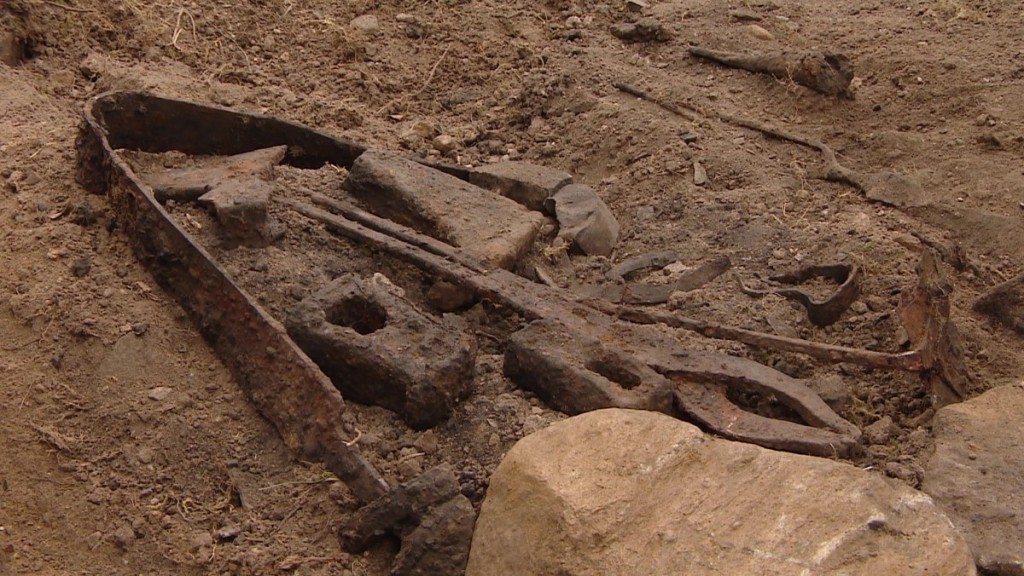
The weapons and tools from the grave

The spectacular remains of what appears to be a Viking grave, most likely belonging to a blacksmith, has been uncovered in Sogndalsdalen, Norway (as reported by NRK). The grave was found by Mr Leif Arne Norberg, under a series of stone slabs in his back garden. Mr Norberg had been carrying out landscaping works when he suddenly spotted a blacksmith’s tongs, followed soon afterwards by a bent sword. On closer examination it quickly became apparent that he had stumbled upon a remarkable Viking Age find. Archaeologists from Bergen University and the County’s Cultural Department were called to the scene and the remains were subsequently excavated. The finds recovered from the grave suggest that it probably dates from the 8th or 9th century AD. They included various pieces of metalwork, a tongs, a sword and an axe, all of which will be conserved before being put on display at the University Museum of Bergen. Personally I can’t wait to find out more information about this exciting discovery.

Read the rest of this article...

Friday, 22 August 2014

Gold coin may be key to solve Sweden's 'Pompeii'


    Archaeologists found the coin on Monday at a site on the island of Ă–land that's been compared to Italy's Pompeii. 
    A small team of archaeologists at Kalmar County museum, in collaboration with Lund University, has been digging at the site for the past three years. The team is studying the Migration Period in Scandinavian history, from about 400 to 550 AD, centuries before the Viking Age.
    Read the rest of this article...

    Saturday, 9 August 2014

    Archaeology: Fifth century Christian basilica found in Bulgaria’s Bourgas


    Archaeologists working in the Kraimorie area of Bourgas on the Bulgarian Black Sea coast have found a Christian basilica said to date from the fifth century.

    The discovery of the early Christian basilica is a rare one for Bulgaria, according to Milen Nikolov, leader of the Bourgas Regional History Museum team that made the find.

    The church building is 19.5 metres long and 15 metres wide.

    At the site, the archaeological team found a chamber for storing relics and a holy water vessel.

    Read the rest of this article...

    Archaeologist try to unlock secrets of Pictish stone


    Archaeologists have released details on what they have described as the most important Pictish stone find to have been made in Moray in decades. 


    The Dandaleith Stone [Credit: Aberdeenshire Council Archaeology Service] 

    Weighing more than a ton and stretching to 1.7m, the Dandaleith Stone dates from the 6th to 8th Centuries and was uncovered during the ploughing of a field near Craigellachie in May 2013. 

    Because of sensitivities around the location as well as the issue of having to work out how to remove a stone of its size - and where to move it to - archaeologists have revealed little about the find until now. 

    The stone was removed from the field in April this year and taken to the Graciela Ainsworth Sculpture Conservation workshop in Leith for assessment. 

    Once this work is completed, the stone will be put on display at Elgin Museum, possibly next year.

    Read the rest of this article...