Archaeological news about the Archaeology of Early Medieval Europe from the Archaeology in Europe web site

Thursday, 28 April 2016

All aboard! Nordic Viking ship ready for Atlantic voyage


The world's largest Viking ship in modern times is about to set sail across the Atlantic.
Named after Harald Hårfagre, the king who unified Norway in the 10th century, the ship's Swedish captain Björn Ahlander was originally supposed to have ordered the great dragon vessel to weigh anchor from Avaldsnes in Norway's Haugesund on Sunday, but the departure was delayed by bad weather.
And time is of the essence. Following in the historical tailwind of Leif Eriksson, the Viking thought to have discovered America centuries before Christopher Columbus, the ship has a long journey ahead, taking a route via Iceland, Greenland and Newfoundland before it finally drops anchor in the United States.
"We've got one month because the only gap, if you don't want to battle low pressure and harsh winds, is May. That's your chance to make it across," Ahlander told the Swedish news agency TT on Monday.
Read the rest of this article...

The Viking Great Army in England: Torksey, treasure and towns


The Viking Great Army in England: Torksey, treasure and towns

Tuesday 3 May 2016, 5.30PM

Speaker: Julian Richards


From AD 865 to 879 a Viking army wreaked havoc on the Anglo-Saxon kingdoms, leading to political conquest, settlement on a substantial scale, and extensive Scandinavian cultural and linguistic influences in eastern and northern England. This critical period for English history led to revolutionary changes in land ownership, society, and economy, including the growth of towns and industry, while transformations in power politics would ultimately see the rise of Wessex as the pre-eminent kingdom of Anglo-Saxon England. 

Read the rest of this article...

‘Lost’ songs from Middle Ages brought back to life


An ancient song repertory will be heard for the first time in 1,000 years this week after being ‘reconstructed’ by a Cambridge researcher and a world-class performer of medieval music. 


Detail from the Cambridge Songs manuscript leaf that was stolen from and then recovered by Cambridge University Library [Credit: Cambridge University] 

‘Songs of Consolation’, to be performed at Pembroke College Chapel, Cambridge on April 23, is reconstructed from neumes (symbols representing musical notation in the Middle Ages) and draws heavily on an 11th century manuscript leaf that was stolen from Cambridge and presumed lost for 142 years. 

Saturday’s performance features music set to the poetic portions of Roman philosopher Boethius’ magnum opus The Consolation of Philosophy. One of the most widely-read and important works of the Middle Ages, it was written during Boethius’ sixth century imprisonment, before his execution for treason. Such was its importance, it was translated by many major figures, including King Alfred the Great, Chaucer and Elizabeth I.

Read the rest of this article...

Sunday, 24 April 2016

Did volcano eruptions tip Europe into Dark Ages?


Back-to-back volcanic eruptions in the mid-6th century darkened Europe's skies for more than a year and may have ushered in the Dark Ages, according to finding to be presented Friday at a science conference in Vienna.
"Either would have led to significant cooling of Earth's surface," said Matthew Toohey, a climate modeller at the GEOMAR Helmholtz Centre for Ocean Research in Kiel Germany who led the research.
"But taken together, the two eruptions"—in 536 and 540—"were likely the most powerful volcanic event affecting the northern hemisphere climate over at least the past 1,500 years," he told AFP at a meeting of the European Geosciences Union.
Their combined impact lowered temperatures by two degree Celsius (3.6 degrees Fahrenheit) during what is probably the coldest decade in the last two millennia, he added.
This sudden drop, caused by a Sun-blocking blanket of sulphur particles in the stratosphere, had a devastating impact on agriculture, provoking famine throughout much of Europe and beyond.
Read the rest of this article...

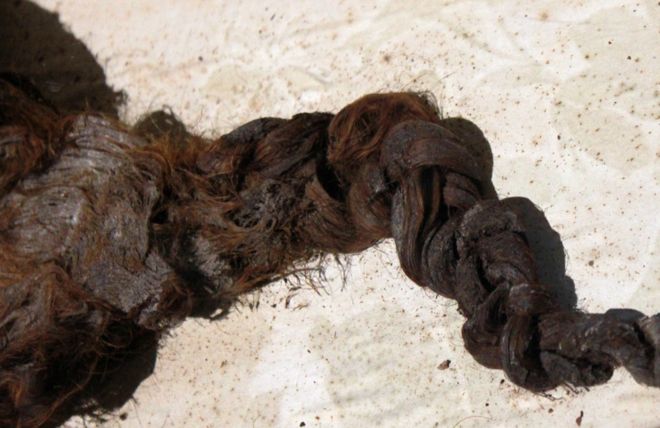
Romsey Abbey: The mystery of the hair in the coffin


For the past few months, archaeologists have been testing a full head of hair found in a coffin. Is it the hair of a saint?
In October 1839, the work of some gravediggers came to an abrupt halt when their tools hit something hard. It was a lead coffin. Inside they found some hair. Human hair.
In the year 2000, a seven-year-old boy called Jamie Cameron went on a school trip to his local parish church, Romsey Abbey in Hampshire. It was where the gravediggers had made their discovery more than a century and a half earlier.
He was taken to a display case and was immediately drawn to the full head of hair, which was still resting on the oak "pillow" on which it was found.

Read the rest of this article...

Friday, 22 April 2016

Searching for the Vikings: 3 Sites Possibly Found in Canada


Another possible Viking site, located at a place called Point Rosee in southern Newfoundland, was discovered using satellite imagery. 

Three archaeological sites that may have been used by Vikings around 1,000 years ago were excavated recently in Canada.

If confirmed, the discoveries would add to the single known Viking settlement in the New World, located at L'Anse aux Meadows on the northern tip of Newfoundland. Excavated in the 1960s, that Viking outpost was used for a short period of time around 1,000 years agoas well.

Sagas from the time of the Vikings tell tales of their journeys into the New World, mentioning places named "Helluland" (widely believed to be modern-day Baffin Island), "Markland" (widely believed to be Labrador) and "Vinland," which is a more mysterious location that some archaeologists have argued could be Newfoundland. [See Photos of the Newfound Viking Sites]

Even so, pinpointing actual Viking remains or other clues of Viking settlements has been difficult, making the three sites — two in Newfoundland and the other in the Arctic — intriguing to archaeologists.

Read the rest of this article...

Solving the mystery of the mummified lung

In 1959 a preserved lung was found by archaeologist Michel Fleury in a stone sarcophagus in the Basilica of St. Denis, in Paris. At this site the kings of France were buried for centuries. Along with the lung skeletal remains, a strand of hair, textile and leather fragments, as well as a golden ring with the inscription “Arnegundis Regine”, were found. Among the grave goods, an elaborate copper belt was also discovered. 


Drawing of the old queen Arnegunde, with the dress she probably  wore when she died 
[Credit: L. Brossard/Inrap] 

The inscription on the golden ring showed the remains belonged to the Merovigian Queen Arnegunde. Arnegunde, Aregunda, Aregund, Aregonda or Arnegonda (c. 515/520-580) was a Frankish queen, the wife of Clotaire I, king of the Franks, and the mother of Chilperic I of Neustria. 

The discovery of the preserved lung raised the question of how it could be preserved while the body was completely skeletonized.

Read the rest of this article...