Archaeological news about the Archaeology of Early Medieval Europe from the Archaeology in Europe web site

Monday, 30 January 2017

How Much Viking Lore Is True?


Archaeologists have confirmed key details in Norse oral histories (but not the dragons, elves, and trolls).


In TV series from Vikings to Game of Thrones, the icy wastes of the north provide the backdrop to dramatic, often violent, stories of kings and warriors, dragons and trolls. The source for many of these dramas is the Icelandic sagas. In her new book, Beyond the Northlands: Viking Voyages and the Old Norse Sagas, historian Eleanor Rosamund Barraclough explores the world of the sagas, teasing fact from fiction to show that there was much more to the Norse peoples than rape and pillage. (Find out whether the Vikings deserved their terrible reputation.)
Speaking from her home in Durham, England, she explains how the United States should really celebrate Leif the Lucky, not Columbus, why the Soviets hated the idea that Russia had been founded by the Vikings, and how the gruesome Viking torture known as the Blood Eagle may have been more poetic conceit than historical practice. (Did Vikings make the modern world possible?)

Read the rest of this article...

Sunday, 29 January 2017

Spectacular Viking manor discovered near Birka


A large Viking manor has been found near the ancient town of Birka in Lake Mälaren.
Birka, on the island of Björkö in Lake Mälaren, 40 kilometres from Stockholm, is thought to be Sweden's oldest town and has been the site of excavations since the 17th century.
But there is still plenty left to be discovered on the island, as Swedish and German researchers' latest find proves.

Thanks to high-resolution geophysical surveys carried out in September 2016, researchers now believe they have located one of the most important Viking halls of the era, situated in the harbour bay of Korshamn, outside of Birka's town boundaries. They believe that it can be dated to the period after 810 AD.

“This kind of Viking period high status manors has previously only been identified at a few places in southern Scandinavia, for instance at Tissø and Lejre in Denmark,” said Johan Runer, archaeologist at the Stockholm county museum, in a statement.
Read the rest of this article...

Vast Ancient Necropolis In Southern France Reveals The Path To Christianity Was Slow


A necropolis from the time of the late Antiquity has been discovered in southern France. More than 300 tombs have been unearthed, and the objects recovered suggest that the path towards Christianity was gradual in the region.


After finding objects from the Neolithic Period, the archaeologists discovered a necropolis 
[Credit: Bernard Sillano, Inrap]

Before construction work could take place to build houses, the French state had mandated archaeological surveys on the land, located in the town of the Bouc-Bel-Air.

A team from the French National Institute for Preventive Archaeological Research (INRAP) began excavating the 21,900 metre square area, quickly finding fossils from the Neolithic Era (from approx. 10,000BC to 3,000BC).

Small pits in the ground were holding objects including ceramic remains and rudimentary tools


A row of holes in the ground indicates the location of where a wooden structure would have been standing, although it is not known what its purpose was.

However, the site was hiding many more secrets. The archaeologists also discovered that the land had later been used as a necropolis, just before medieval times. A total of 315 tombs were identified, with a great variety of funerary practices documented at the site.

Most of the tombs had simply been covered with tiles but others held the remains of people who had also been placed in wooden or lead coffins. A number of amphora burials – wherein remains of infants or fetuses are put in large jars – were also recovered.


Read the rest of this article...
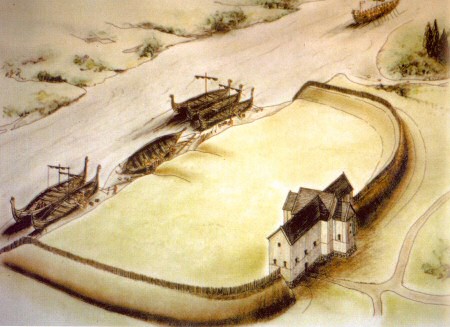
'Warrior Of High Status' Was Buried At Scottish Viking Boat Burial Site


The excavation of a rare, intact Viking boat burial in western Scotland has been set out in detail for the first time.

The boat burial is the first found intact on the UK mainland [
Credit: Ardnamurchan Transitions Project]

Artefacts buried alongside the Viking in his boat found in Ardnamurchan suggest he was a high-ranking warrior.

In a report published by Antiquity, archaeologists describe the finds including a sword, spearhead and 213 of the boat's rivets.

The weapons indicate the burial of "a warrior of high status".

Archaeologists, including Dr Oliver Harris of the University of Leicester, first revealed the discovery at Swordle Bay in 2011.

Since then experts have been studying the burial site and its "rich assemblage of grave goods".

Among them were a single copper alloy ringed pin, thought to have been used to fasten a burial cloak or shroud, a broad bladed axe, a shield boss and whetstone made from rock found in Norway. Also found were mineralised remains of textiles and wood.


Read the rest of this article...

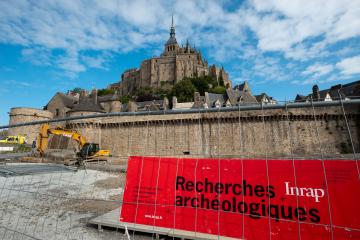
L’INRAP FOUILLE AU MONT-SAINT-MICHEL


En 2005, une équipe de l’Inrap avait mis au jour de nombreux moules en schiste destinés à la fabrication d’enseignes de pèlerinage, à l’emplacement d’un atelier de production daté des XIVe-XVe siècles, près de l’entrée de l’abbaye. La variété et la qualité de ces pièces en font aujourd’hui une collection de référence en archéologie médiévale.
En 2011, les archéologues ont révélé les vestiges d’une tour des fortifications, la tour Denis, ouvrage édifié vers 1479 et détruit en 1732.
En 2015, d’anciennes maisons, donnant sur la grève et détruites en 1368, ont été étudiées.

Dans l’abbaye, l’Inrap a suivi plusieurs chantiers de restauration conduits par l’architecte en chef des Monuments historiques dont les opérations importantes menées sur la Merveille, sur l’ancienne Hôtellerie de Robert de Torigny et sur les Logis abbatiaux.
Aujourd’hui, la recherche des fortifications et de la porte du XIIIe siècle a permis la découverte, inattendue, du cimetière paroissial.

Read the rest of this article...

Wednesday, 25 January 2017

Scientists divided over whether 'Furku.Al' rock inscription is genuinely the work of Vikings


When a resident on the Isle of Eigg decided to clean his drains, he had no idea that he would stumble upon a mystery that would baffle archaeologists around the world.

The islander’s discovery of a boulder with the letters “Furku.Al” scratched into its surface has sparked a lively debate among experts as to whether it is a genuine runic inscription.

The resident alerted Camille Dressler, chair of the Eigg History Society, about his potentially significant find, and she sent a photograph to Historic Environment Scotland (HES).

“It looks quite ancient. We are intrigued by it,” Ms Dressler told The Daily Telegraph. “We just hope it is a genuine Norse inscription as that would highlight the Norse heritage of the island.”

Read the rest of this article...

Thursday, 12 January 2017

Bringing Vikings Back to the East Midlands


The Centre for the Study of the Viking Age is pleased to report that we have been awarded a substantial grant from the Arts and Humanities Research Council Follow-On Fund for a project called Bringing Vikings Back to the East Midlands. The project will fund a variety of initiatives and events related to the British Museum/York Museums Trust travelling exhibition on the Vikings which will be on at Lakeside from November 2017 to March 2018. CSVA alumnus Dr Roderick Dale will start as Cultural Engagement Fellow on the project on 1st February. More details to follow.

Read the rest of this article...


Read the rest of this article...