Archaeological news about the Archaeology of Early Medieval Europe from the Archaeology in Europe web site

Monday, 10 August 2020

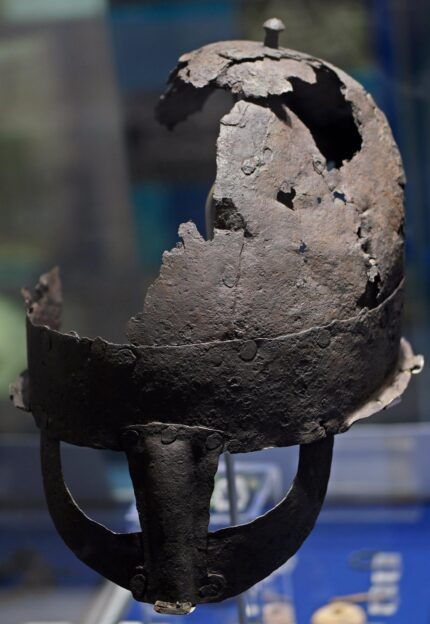
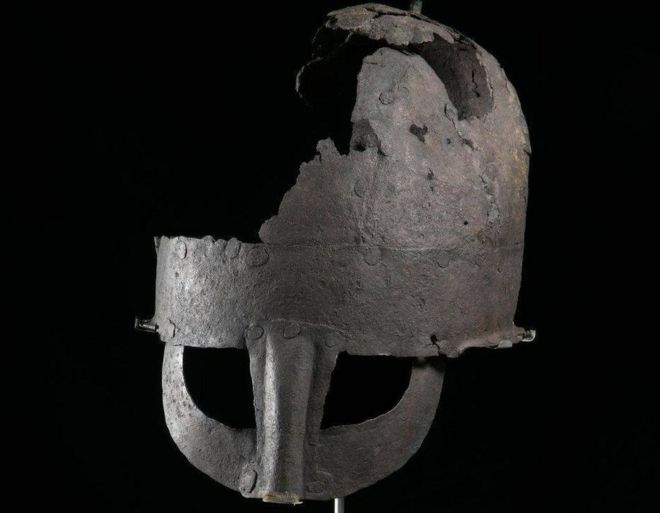
Yarm Viking helmet 'first' to be unearthed in Britain

The Viking helmet was essential personal protective equipment for a warrior
DURHAM UNIVERSITY

A Viking helmet unearthed in Yarm in the 1950s is the first to ever be found in Britain, according to new research.

Found in Chapel Yard by workmen digging trenches for new sewerage pipes, the corroded, damaged artefact is a rare, 10th century Anglo-Scandinavian helmet.

A research project led by Dr Chris Caple also found it is only the second near-complete Viking helmet found in the world.

It has been on display at Preston Park Museum since 2012.

The age of the helmet had caused much debate until now.

Researchers used evidence from recent archaeological discoveries as well as analysis of the metal and corrosion to reveal its past

Read the rest of this article...

A new analysis of 1st Temple-era artifacts, magnetized when Babylonians torched the city, provides a way to chart the geomagnetic field – physics’ Holy Grail – and maybe save Earth The Bible and pure science converge in a new archaeomagnetism study of a large public structure that was razed to the ground on Tisha B’Av 586 BCE during the Babylonian conquest of Jerusalem. The resulting data significantly boosts geophysicists’ ability to understand the “Holy Grail” of Earth sciences — Earth’s ever-changing magnetic field. “The magnetic field is invisible, but it plays a critical role in the life of our planet. Without the geomagnetic field, nothing on Earth would be as it is — maybe life wouldn’t have evolved without it,” Hebrew University Prof. Ron Shaar, a co-author of the study, told The Times of Israel. In the new study published in the PLOS One scientific journal, lead author and archaeologist Yoav Vaknin harvested data from pieces of floor from a large, two-story building excavated in the City of David’s Givati parking lot. Minerals embedded in the dozens of floor chunks were heated at a temperature higher than 932 degrees Fahrenheit (500 degrees Celsius) and magnetized during the slash and burning of ancient Jerusalem, and therefore offered up geomagnetic coordinates. Read the rest of this article...

An iron helmet that was discovered in Yarm, North Yorkshire, during sewer work in the 1950s has been confirmed to be an extremely rare Viking-era helmet, only the second nearly complete Viking helmet in the world and the first and only one found in Britain.

It was referred to as the Viking helmet from the beginning, but its real age has been an open discussion since its find. It has design elements found in earlier forms from the Anglo-Saxon and Vendel era, and because the only other helmet in the world confirmed to date to the Viking era, the Gjermundbu Helmet found in Haugsbygd, Norway, in 1943, was not a direct comparison, it was difficult to conclusively identify the Yarm Helmet as an Anglo-Scandinavian piece. A new study by Durham University researchers has used recent archaeological finds and analysis of the iron and corrosion products to narrow down its age of manufacture. It is indeed an Anglo-Scandinavian helmet made in northern England in the 10th century.

Read the rest of this article...

Wednesday, 5 August 2020

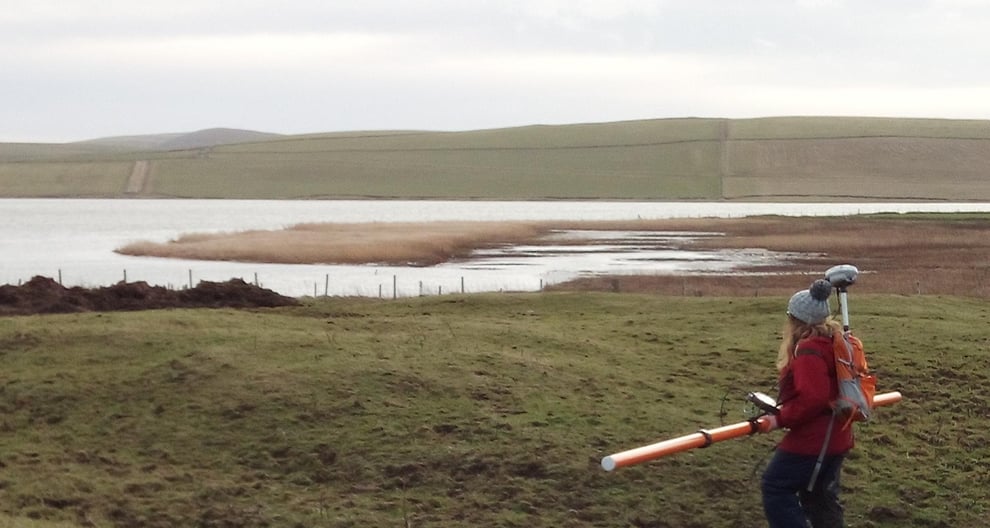
Lost Viking waterway found in Orkney

The lost Viking waterway likely connected farms on Orkney Mainland to the power bases of the Norse earls on the north west coast at Birsay. PIC: St Andrews University.

The route was discovered after a series of Old Norse place names in the centre of the mainland, which were connected to sea and boats despite being many miles from the sea, attracted interest from researchers.

Now it is believed that Vikings were using a route from Harray in the central mainland through the Loch of Banks to a portage at Twatt before reaching the Loch of Boardhouse and ultimately the coastal powerbases of the Norse Earls at the Brough of Birsay, a tidal island off the very tip of the north west coast.

The waterway network would have provided a shallow route through which the Vikings were able to haul both their boats and heavy goods, such as grain.

Taxes and rents may have been gathered from the farms around Harray and transported on the waterway to Birsay with the route also offering a way to the waters of Scapa Flow and the North Atlantic.

Read the rest of this article...

Ancient Viking waterway discovered in Orkney


A lost Viking canal system that acted as a trade and transport highway, has been discovered running through Orkney.

The route connects the North Atlantic with the Scapa Flow and crosses the Scottish archipelago’s mainland.

A series of Old Norse place names around the island, connected to the sea and boats, first sparked the interest of researchers who then began investigations.

Modern scientific methods, geophysical mapping and sediment samples have now revealed that the area was connected through a series of ancient canals.

Read the rest of this article...

Monday, 27 July 2020

Norway's Gjellestad burial mound belonged to the Iron Age elite

The soil samples were taken from the mound construction, in the presumed subsoil
and in the trench for the ship burial [Credit: NIKU]

Recent geoarchaeological and geophysical analysis show that the construction of the Gjellestad ship mound was carefully planned and executed.

Five soil samples from the burial mound have been analyzed by researchers from the Norwegian Institute for Cultural Heritage Research (NIKU) and the University of Oslo. These were taken during excavations done by the Museum of Cultural History during autumn of 2019.

One of these samples was taken from the ship grave itself, from within the layer of soil inside the ship. The other samples were taken from the remnants of the mound that surrounded the ship.

The purpose of the analyses was to determine if these were able to reveal anything about what is visible in the 2018 dataset from the ground-penetrating radar (GPR) examinations, and if this could provide more information about how the mound was constructed.

Read the rest of this article...

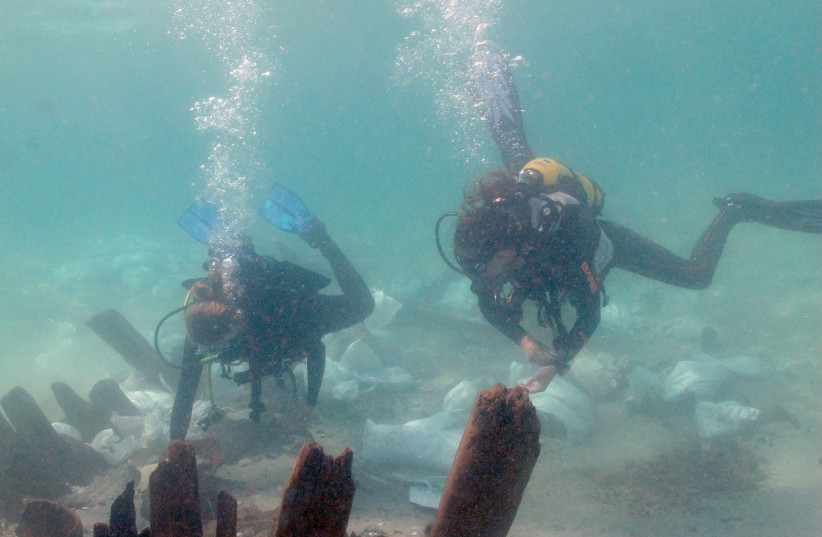
Christian, Muslim symbols found in 7th century shipwreck in Israel

Students Maayan Cohen and Michelle Creisher examine the pottery near the bulkhead at Ma‘agan Mikhael B shipwreck.
(photo credit: A. YURMAN/LEON RECANATI INSTITUTE FOR MARITIME STUDIES OF THE UNIVERSITY OF HAIFA.)

About 1,300 years ago, a 25-meter-long ship sank just a few dozen meters from the coast of Israel. Most likely, nobody perished in the incident.

But its plentiful cargo included 103 amphorae filled with all forms of agricultural products, numerous daily objects used by the crew and many other unique features, such as several Greek and Arabic inscriptions. They were swallowed by the sea and the sand, which preserved their secrets for centuries.

First spotted by two members of nearby Kibbutz Ma’agan Michael, about 35 km. south of Haifa, the site was again covered by sand and rediscovered in 2015.

The shipwreck has been excavated by the University of Haifa’s Leon Recanati Institute for Maritime Studies since 2016. It has offered archaeologists unique insights into the life of the region at the time of the transition between Byzantine and Islamic rule, trade routes and ship construction.

Read the rest of this article...

Sunday, 26 July 2020

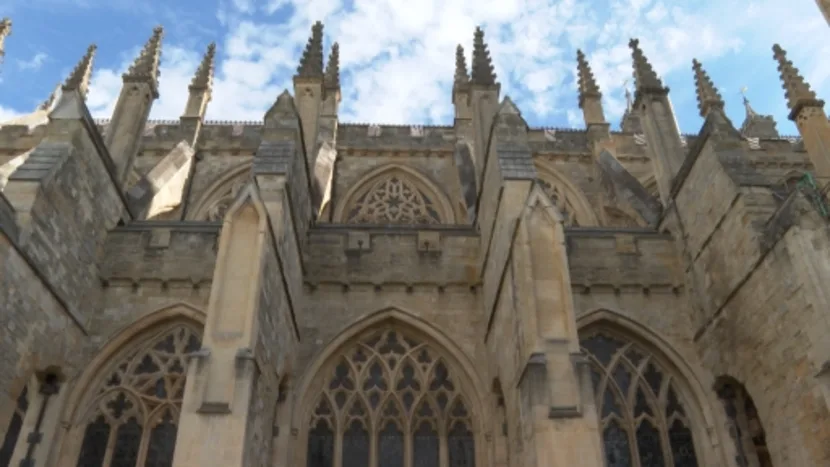
Archaelogical dig starts at Exeter Cathedral


An archaeological dig which has just started at Exeter Cathedral could uncover artefacts as far back as the Romans.

The first stone has been lifted in a six-week investigative dig where a new cloister gallery will ultimately be built.

Archaeologists want to find out what is below the paving slabs and grass which covers the area just outside the cathedral's chapter house, which has never been examined before.

The dig is expected to provide crucial information about the layout of the medieval cloister - which was torn down in 1657 - and the state of its foundations which, if still serviceable, will be reused for the new building.

Read the rest of this article...