Archaeological news about the Archaeology of Early Medieval Europe from the Archaeology in Europe web site

Wednesday, 29 November 2023

Possible 1,400-Year-Old Temple Excavated in Eastern England


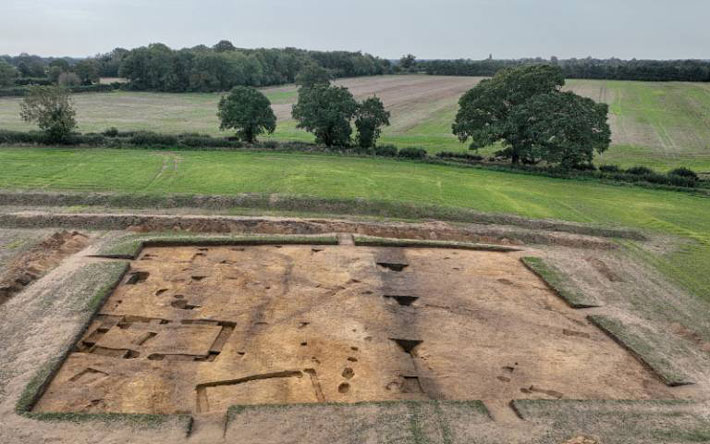
RENDLESHAM, ENGLAND—In the eighth century, an English monk and historian known as The Venerable Bede wrote of a king’s village at “Rendlaesham,” and of a temple equipped with both Christian and pre-Christian altars. BBC News reports that the site of a possible 1,400-year-old temple has been uncovered at Rendlesham in eastern England, which is located near Sutton Hoo, the archaeological site where East Anglian king Raedwald is thought to have been buried in A.D. 625. The possible temple structure measured more than 30 feet long and 16 feet wide, and had been built with substantial foundations. The excavation also uncovered evidence of a ditch that may have surrounded the royal village, traces of two other timber buildings, and a mold used for casting fine pieces of decorative horse harnesses similar to those unearthed at Sutton Hoo.

Read the rest of this article...

Video Shows Fragments Falling from the Dome of Hagia Sophia

A still from a recently released video shows visitors rushing to take cover as fragments fall from the dome of Hagia Sophia. Credit: Daily Motion/BirGün

A video from 2022 that came to light recently shows fragments falling on visitors from the dome of Hagia Sophia, the former epicenter of Christian worship at Constantinople, today’s Istanbul.

The footage released by the Turkish newspaper, BirGün, raises serious questions over the safety of the former Orthodox Christian cathedral, now a mosque.

BirGün notably quoted officials as saying that “pieces are falling from the roof, due to the humidity created by the crowd, but no precautions are being taken”.

Read the rest of this article...
More Than 100 Cultural Landmarks Have Been Destroyed During Gaza Airstrikes, Report Says


Israel’s repeated airstrikes on Gaza have destroyed more than 100 cultural landmarks and historic sites according to a preliminary report by the Catalonian NGO Heritage for Peace that was released earlier this month.

The airstrikes, which took place after the October 7 Hamas attack that killed 1,400 Israelis and involved the taking of 240 hostages, have “destroyed or damaged” roughly 45 percent of housing in Gaza, leading to what the United Nations has called a “humanitarian catastrophe.”

Historic religious sites, museums, and archaeological sites have been destroyed, the report says, noting that Gaza has been a cultural hub for every civilization that has conquered the region, from Egypt in the early 15th century BCE, to the Greeks under Alexander the Great, to the Roman and Byzantine Empires.

Read the rest of this article...
Monday, 27 November 2023

Viking-era graves found in the heart of Gothenburg, Sweden


A report just published by the Gothenburg City Museum confirms that the graves found in Burgårdsparken this summer date to the Viking era.

Two graves discovered this summer in the center of Gothenburg by archaeologists from the City Museum date back to the Viking era, according to a Swedish-language report the museum has just published.

A first for Gothenburg 

These are the first such finds in central Gothenburg, Sweden's second-largest city. The location, the pretty gardens of Burgårdsparken, is close to Gothenburg's main football stadium, the Ullevi, where the 1958 World Cup Final was played. 

The chief archaeologist on the dig, Ulf Ragnesten, suggests that further investigations are required. The remains are protected by Sweden's Cultural Environment Act. 

Read the rest of this article...

Sunday, 26 November 2023

Medieval building discovered by archaeologists in Germany


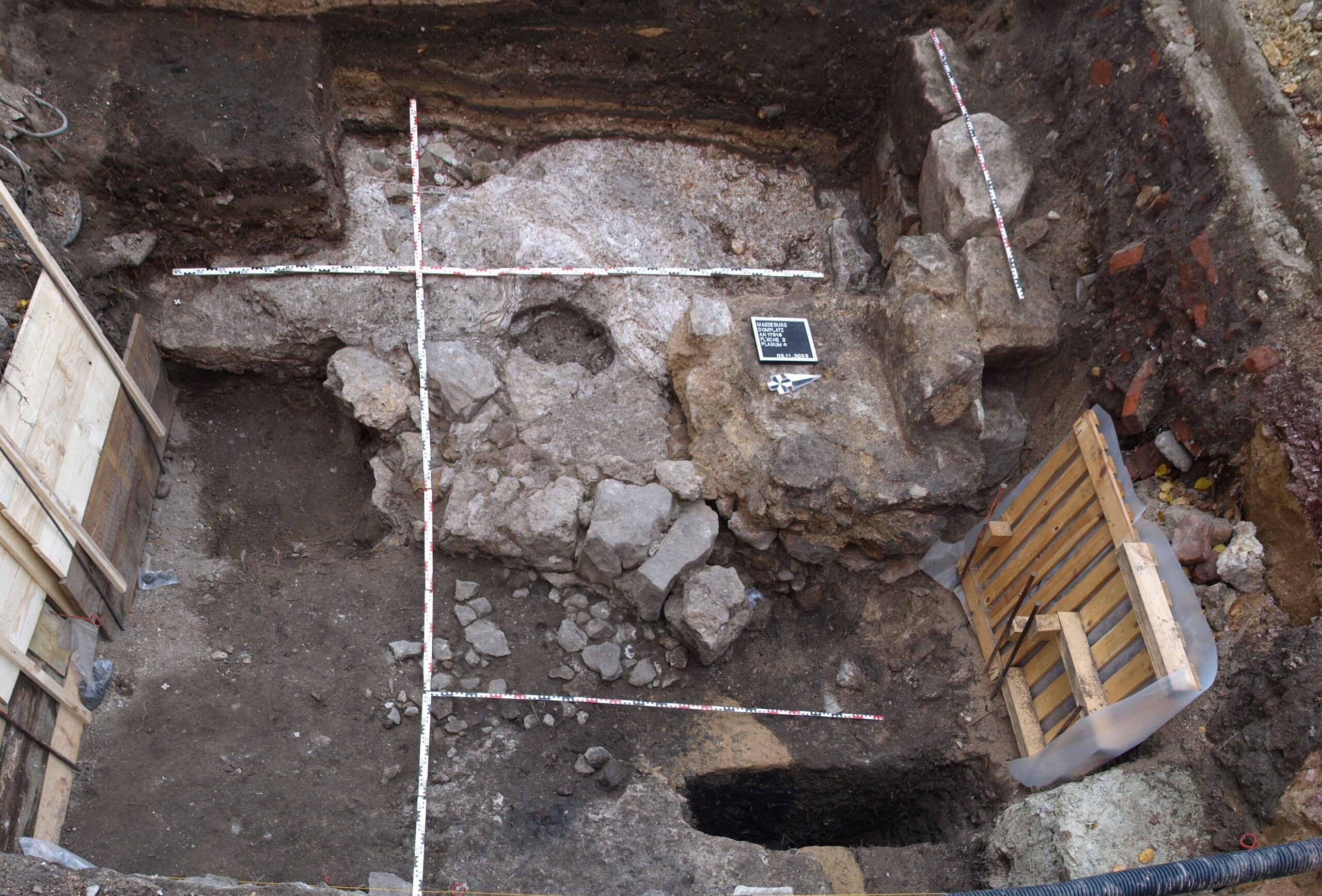
Archaeologists working at Magdeburg’s Cathedral Square in eastern Germany have uncovered the remains of a large medieval building thought to be over a thousand years old. 

The archaeological dig, which is being carried out by the State Office for Heritage Management and Archaeology Saxony-Anhalt and the University of Heidelberg, only began last month but has already produced outstanding results.

For the first time, actual architectural remains were found in the form of two walls – the outer wall of a semicircular room (apse) and a wall base at its north end that runs west – which can be assigned to a building from the Ottonian period (919–1024). On the former outside of the building, both walls to the west have a sloping base made of plaster mortar, which was primarily used to protect against moisture. The outer wall of the apse appears to have been structured by half-columns or pilasters. It was part of the western end of the building, which extended to the east parallel to a cathedral that was built around the same time.

Read the rest of this article...

Wednesday, 22 November 2023

1,400-year-old temple discovered in England


Sutton Hoo has been home to some of the most amazing discoveries from Early Medieval England. Now, archaeologists have uncovered the remains of a 1400-year-old, possible pre-Christian temple in the same area.

The discovery was made this summer near the village of Rendlesham in southeastern England, as part of digs conducted by Suffolk County Council’s Rendlesham Revealed community archaeology project. This comes from the same project that last year uncovered the remains of a large timber Royal Hall, confirming the location as a royal settlement of the East Anglian Kings.

This year’s excavations also uncovered evidence of fine metalworking associated with royal occupation, including a mould used for casting decorative horse harnesses similar to that known from the nearby princely burial ground at Sutton Hoo. The royal compound was found to have been more than twice the size that was previously thought, bounded by a 1.5 kilometre-long perimeter ditch that enclosed an area of 15 hectares (the equivalent to about 20 football pitches).

Read the rest of this article...

Wednesday, 15 November 2023

Scandinavia’s Oldest Identified Ship Burial in Trøndelag “Rewrites History”


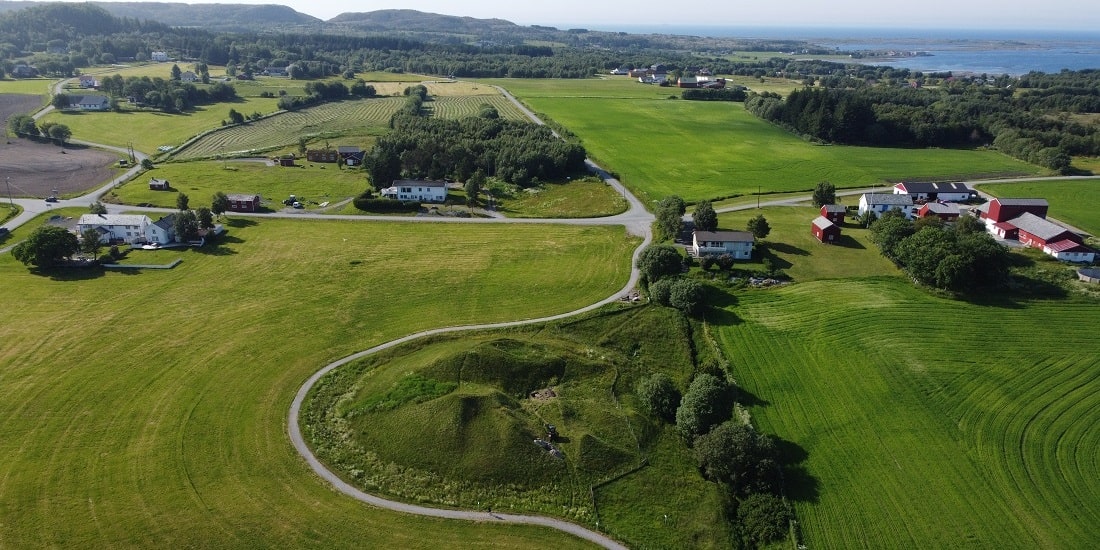
In Leka, a municipality in Norway’s Trøndelag county, archaeologists have uncovered Scandinavia’s oldest identified ship burial, dating back to around 700 AD.

This summer, archaeologists carried out a small survey of the 60-meter mound Herlaugshaugen, a site mentioned in Snorre’s royal sagas as the final resting place of King Herlaug.

Herlaugshaugen is one of the country’s largest burial mounds. In the late 1700s, it was excavated three times. According to reports, findings included a type of wall, iron nails, a bronze kettle, animal bones, and a seated skeleton with a sword.

“Unfortunately, these findings disappeared already in the early 1920s. The skeleton was once displayed at Trondheim Cathedral School as King Herlaug, but no one knows where it ended up,” explained Geir Grønnesby, project leader from NTNU Science Museum.

Read the rest of this article...