Archaeological news about the Archaeology of Early Medieval Europe from the Archaeology in Europe web site

Monday, 17 July 2017

Breakthrough in dating Viking fortress

In 2014 archaeologists discovered the previously unknown Viking fortress at Borgring south of Copenhagen. Since then the search has been on to uncover the life, function, destruction and, not least, the precise dating of the Viking fortress. Now a new find has produced a breakthrough in the investigation.


The carved oak timber object recently found in peat layers just outside the south gateway of the fortress. The piece has been cut and sampled for dendrochronological sampling (left). The function of the piece is unknown, but it may be a part of a door or building.

Credit: The Museum of South East Denmark / Nanna Holm

In the period 2016-18 a programme of new excavations is made possible by a grant from the A.P. Møller Foundation. The team from the Museum of South East Denmark and Aarhus University are joind by leading experts from the Environmental Archeology and Materials Research at the Danish National Museum and the National Police Department's Section for arson investigation. Prior to this year's excavations it was only known that the massive, 150m wide fortress dated to the tenth century. Experts suspected that it was built in the reign of Viking king Harold Bluetooth (c.958-c.987), but the association could not be proven.
On June 26, the archaeological team opened new trenches is the meadow next to the fortress to search for evidence of the landscape surrounding the fortress. Around 2.5 meters below the current surface of the valley was found a c. 1m long piece of carved oak wood with drilled holes and several wooden pegs in situ. The wood carries clear traces of wear, but it is not currently possible to say what function the wood piece has had.
Read the rest of this article...

Sunday, 16 July 2017

One of the most important buildings in history of Christianity discovered off Scottish coast


Archaeologists have located one of the most important buildings in the history of Western European Christianity – but it’s not a vast cathedral or an impressive tomb, but merely a humble wattle and daub hut on a remote windswept island.
Using radiocarbon dating techniques and other evidence, the  scholars –  from the University of Glasgow – believe they have demonstrated that the tiny five-metre square building was almost certainly the daytime home of early medieval Scotland’s most important saint, St Columba.
Located on the island of Iona, off the west coast of Scotland, the unprepossessing hut was probably the first administrative hub of the monastic community he founded – and whose monks, over succeeding centuries, went on to establish similar monasteries in mainland Scotland, in north-east England, in Belgium, in France and in Switzerland.
Read the rest of this article...

Tintagel excavations reveal refined tastes of medieval settlers

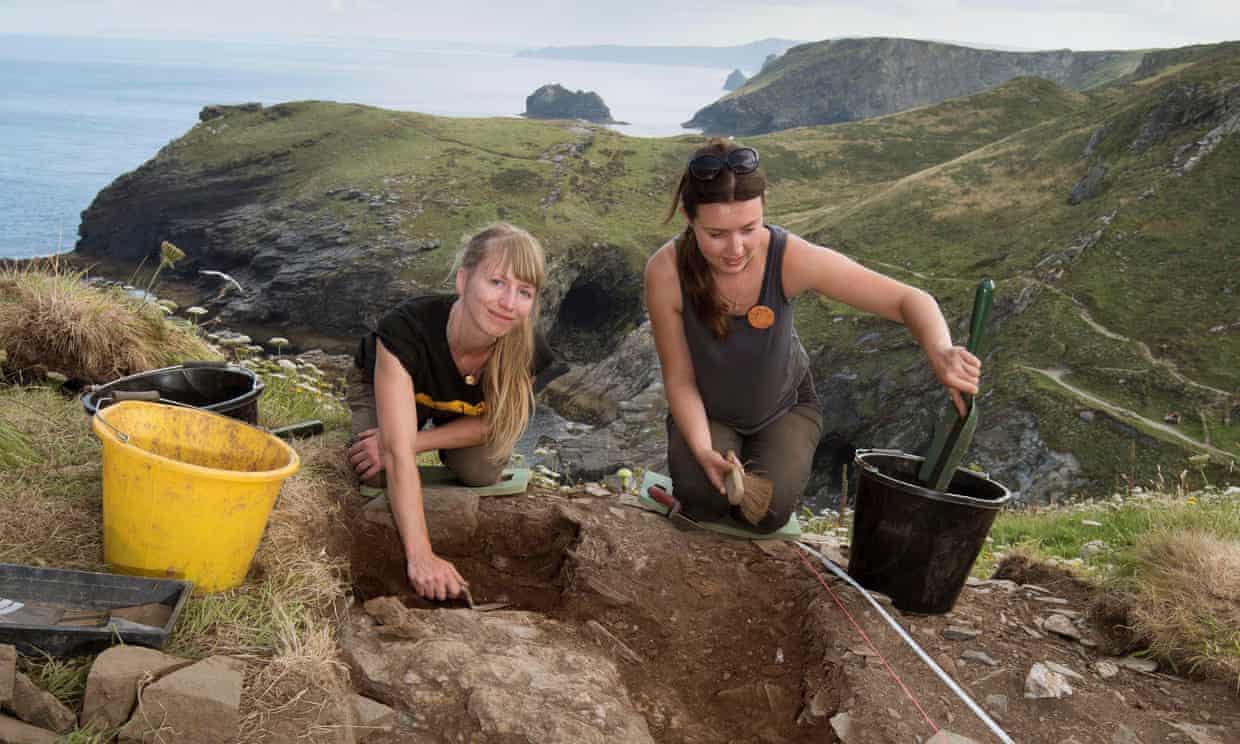
 Archaeologists conducting the first research excavations at Tintagel in decades. 
Photograph: Emily Whitfield-Wicks/English He/PA

Early Cornish kings feasted on a diet of oysters, roast pork and fine wine, eating and drinking from bowls imported from Turkey and glass goblets from Spain, a new dig at Tintagel Castle has suggested.
Discoveries made by the Cornwall archaeological unit (CAU) support the view that Tintagel was a royal site during the 5th and 6th centuries, with trading links reaching as far as the eastern Mediterranean.
Perched on Cornwall’s rugged north coast, Tintagel has for centuries been associated with the legend of King Arthur. Over the past 18 months, its custodian, English Heritage, has been accused of putting too much emphasis on the stories of Arthur and Merlin, rather than focusing on the site’s true, ancient Cornish heritage. The excavations, the first at Tintagel for decades, may help redress the balance.
Read the rest of this article...

Tintagel excavations reveal refined tastes of early Cornish kings

Tintagel is intricately bound up in the legend of King Arthur 
[Credit: Emily Whitfield-Wicks/English Heritage Trust]

Discoveries made by the Cornwall archaeological unit (CAU) support the view that Tintagel was a royal site during the 5th and 6th centuries, with trading links reaching as far as the eastern Mediterranean.

Perched on Cornwall’s rugged north coast, Tintagel has for centuries been associated with the legend of King Arthur. Over the past 18 months, its custodian, English Heritage, has been accused of putting too much emphasis on the stories of Arthur and Merlin, rather than focusing on the site’s true, ancient Cornish heritage. The excavations, the first at Tintagel for decades, may help redress the balance.

The excavation also uncovered stone-walled structures on the southern terrace of Tintagel’s island area, with substantial stone walls and slate floors, accessed by a flight of slate steps.

Read the rest of this article...
Sunday, 9 July 2017

Pearls, Viking swords, spears and shields among hundreds of items excavated in N. Iceland


THE SECOND SWORD Both swords were badly damaged by rust. 
Photo/Hildur Gestsdóttir, Twitter.

Archeologists working at Dysnes, a recently discovered Viking age burial site in Eyjafjörður fjord in North Iceland are still busy excavating invaluable treasures. Hundreds of items have been found at the site, among them two swords, three spears and three shields. 

2 out of 6 burials fully explored

A total of six Viking age graves have been found at the site, including two confirmed boat burials. Only two of the burials have been fully excavated and archeologists are currently exploring the third burial. The site is unusual for many reasons, not least that two boat burials have been discovered: Viking age boat burials are very rare in Iceland. 

Read the rest of this article...

Wednesday, 5 July 2017

New discovery could rewrite Viking fortresses’ history

Someone brought ceramics through the gates at the Viking ring fortress “Borgring” after it had burnt down. The discovery reveals an afterlife at the fortress that archaeologists had not previously considered. (Photo: Screenshot from video by Archaeological IT Aarhus University)

While most archaeologists and historians can agree that Denmark’s five Viking ring fortresses were most likely built by Harold Bluetooth around 980 CE, they remain divided regarding their purpose.
Was it to defend the kingdom? A demonstration of power? Or to cement the Christianisation of the Danes?
Many archaeologists think that the fortresses were built with just one goal in mind, and then disappeared more or less as fast as they had appeared in the first place.
But newly discovered pieces of ceramic pottery found in the main gates of Denmark’s fifth Viking ring fortress, “Borgring,” are now challenging this theory.
The pottery belongs to the first half of the 11th century, which puts it well after the assumed construction of the fortress. Shards of the same type of pottery were discovered in 2016 at the fortress’ eastern gate.
Read the rest of this article...

One of Britain’s oldest churches discovered on Holy Island of Lindisfarne


Archaeologists have discovered one of Britain’s oldest churches.
The find – on the Holy Island of Lindisfarne, off the Northumberland coast – is of great historical importance because the newly discovered ancient church may originally have been built in or shortly after the mid 7th century AD as part of the monastic spiritual epicentre from which much of northern and central England was eventually Christianised.
It’s also important because it is likely to have been a key site at the spiritual heart of the early 8th-century monastic community that made Britain’s most famous early medieval illuminated manuscript – the Lindisfarne Gospels.
The evidence suggesting that this could be the site of one of Holy Island’s original early Anglo-Saxon period churches – perhaps even one built by the founder of Lindisfarne, St Aidan – is complex but persuasive.
Read the rest of this article...